
Multi-op env, US China energy differential, Gemini 3, AI crawling, Making time

You're always engineering your way toward something; are you sure it's what you want?
+ Continuously updated briefings on emerging tech + macro signals
+ Leadership learnables and playbooks
+ Think clearly and lead confidently in 2026
Click here to get full access for half price
Offer Ends Friday Night Midnight
🎧 Listen here or on Spotify
In this Issue
- 🧭 Leaders must navigate intertwined environments—tech, economic, social, and natural systems—and recognize how their choices shape downstream behavior.
- 🔍 Sharpen system-level awareness with multi-environment dashboards, second-order thinking, weak-signal detection, and incentive mapping.
- 🤝 Boost relationship density & cross-domain networks to improve prediction, resilience, and decision quality.
- ⚡ Power = the real AI bottleneck—China’s massive electricity capacity gives it an advantage as U.S. data centers face grid-supply constraints.
- 🤖 Gemini 3 rises—new benchmarks show it outperforming ChatGPT in several categories, shifting the competitive frontier.
- 📚 AI firms strain Wikipedia—intensive crawler traffic drives up operating costs, prompting new funding and licensing discussions.
- 🧪 Change Leadership Focus: Leading change requires more time—this week’s tool shows how to reclaim bandwidth while advancing long-term innovation.
[strategy]
Do you really understand your operating environments? (There isn't just one)
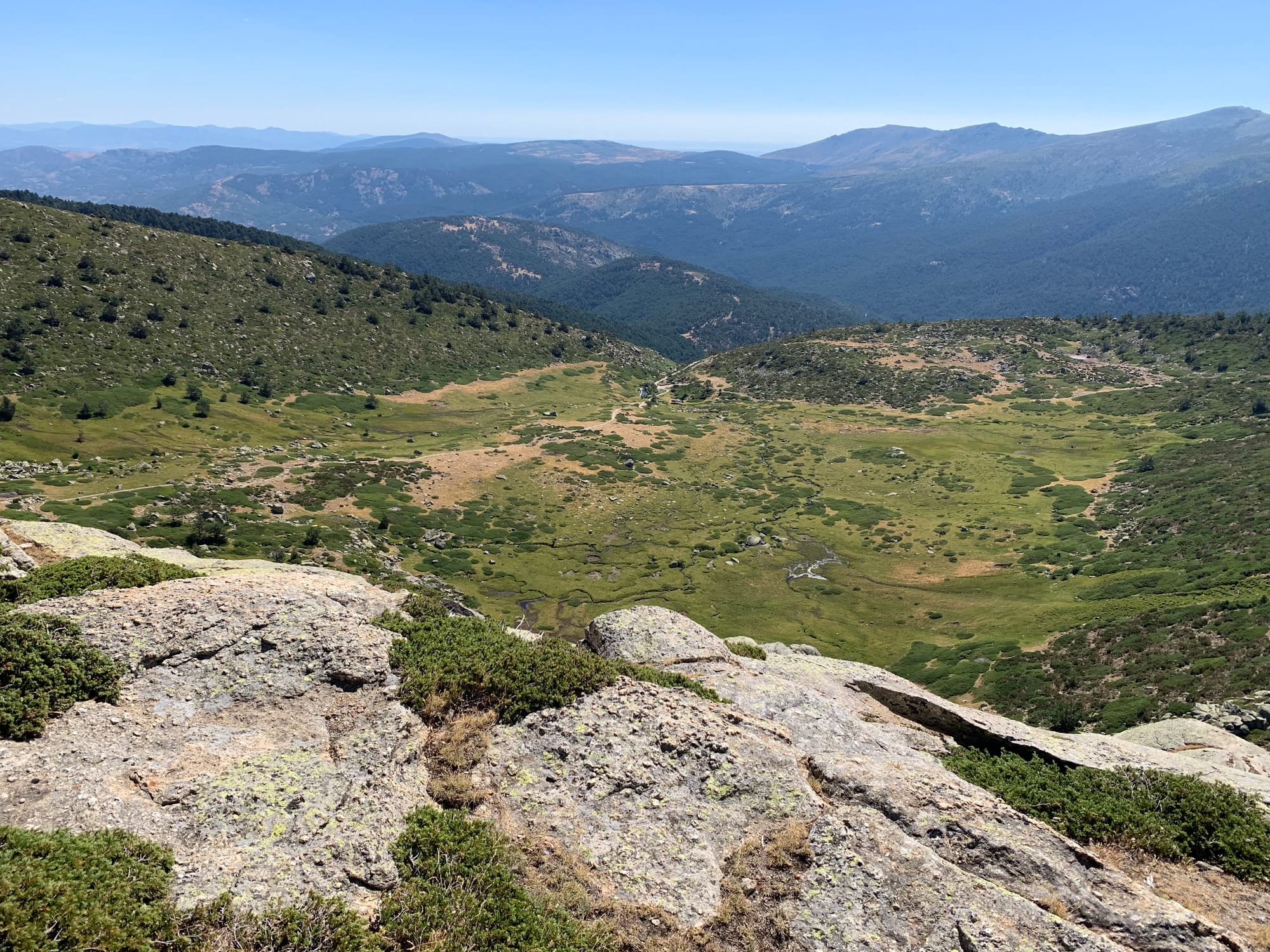
A few years ago, my family went hiking in a beautiful mountain range outside Madrid. It was a true wilderness—miles of terrain folding into other miles. Our guide seemed uncannily aware of every path and feature, what animals were in the area, weather conditions and more. He seemed especially intuitive about helping our group have a good time and stay safe in spite of their varying degrees of fitness and skill. He knew the specific steps and moves to make, so that everyone could navigate the tricky terrain.
Half impressed, half testing him, I said, “You really know this place.”
He smiled. “Like my own home.”
By the end of the hike, we all understood exactly what he meant. He didn’t just move across the landscape—he understood it at a level of detail and familiarity that not only allowed him to find his way, but also allowed him to lead others.
- The trail system and conditions
- The weather
- The animal ecosystem
- What we could eat or drink and what we couldn't
That is the level of awareness change leaders need today. This is especially true for leaders who are bringing organizations, customers, boards, regulators navigate unfamiliar terrain: AI, crypto, digitally-rewired global markets, life science frontiers and other innovations.
There is more than 1 environment
We often talk about “the environment” as if it refers only to nature. Or our "operating environment" as if there's only one. Not true. We all operate inside multiple, interconnected environments—ecosystems where cause and effect happen continuously:
- Technological ecosystems: AI models, compute markets, crypto protocols, security assumptions.
- Economic environments: Inflation expectations, capital flows, institutional trust, regulatory posture.
- Social and democratic environments: Cultural fragmentation, information ecosystems, governance stressors.
- Community and family environments: The micro-systems that shape our customer's well-being, focus, and ultimately our and their futures.
These environments aren’t abstract—they literally are concrete evidence of the cumulative behaviors, incentives, architectures, and decisions made by millions of people.
A canyon tells the story of how water shaped rock over time.

Our social, economic, and technological environments tell the story of the ecosystems we shaped—intentionally or unintentionally.
Consider:
- A Fortune 100 company can receive massive financial support after strategic failure.
- A young family that misses a bill deadline receives a punitive fee.
These aren’t accidents. They emerge from the mental models, platforms, algorithms, processes, and incentives we build and accept.
AI, crypto and other emerging tech innovators should take this to heart:
Every model release, governance change, incentive tweak, UX decision, or protocol upgrade shapes downstream behaviors at scale.
If the world feels chaotic or imbalanced, the first step is uncomfortable but liberating:
We helped engineer these environments—through action, inaction, and the systems we built or tolerated.
This recognition is powerful because it restores agency. It reframes us from victims of systems to designers of systems. Every day we are engineering and navigating our way toward something. Are we sure it's something we really want??
The S3T Philosophy: Awareness as a Tool for Impact
At S3T, we focus on building awareness of the environments that matter most in the 21st century:
- The economic environment, and how emerging tech reshapes its flows
- The technological environment, especially AI and decentralized systems
- The social and political environment, and how polarization impacts governance
- The natural environment, whose stability is critical to all other systems
To navigate these well, we need to engage with them like our hiking guide did:
with familiarity and deep observation.
Awareness isn’t the final goal—but the starting point for intentional, beneficial impact. For work that makes a positive difference.
In the S3T point of view we should use this awareness to work more effectively toward a healthy wealthy world (and not be satisfied with just a few healthy, wealthy individuals).
Being aware of these different ecosystems or environments allows us to make better choices, take better actions and drive better outcomes.
Why Work Toward a Healthy, Wealthy World?
The following points outline the S3T point of view on how we should be thinking and working:
- A healthy wealthy world is a worthwhile outcome to work toward. Why?
- A problem solving mindset that learns and works toward a healthy wealthy world will achieve more good than a pessimistic mindset that retreats into despair.
- A healthy planet requires healthy ecosystems - including natural, social and financial.
- Healthy ecosystems require healthy communities.
- Healthy communities require healthy individuals.
Think of these as sets of things that work together and impact each other. We must combine our individual skills and perspectives into sets of initiatives that effectively address challenges we face.
Nurturing the health and wealth of indviduals, communities, ecosystems and the planet is a high calling that offers an opportunity for every person's diverse gifts and talents. In fact, today's complex problems require the combinatorial advantage of diverse skills working together.
We are all system participants—and often system architects. Being aware of our environments helps us navigate with better decisions and better execution to better outcomes. This is the highest form of innovation because it serves not just a few beneficiaries, but entire ecosystems. A healthy wealthy world ...not just a few healthy wealthy individuals.
Change Leadership Strategies for Increasing Environmental Awareness
Here are practical ways frontier-minded executives and researchers can sharpen their situational awareness of the multiple environments we operate in today.
1. Adopt a “Multi-Environment Dashboard Habit”
Just as engineers monitor model drift or validator performance, leaders should create a weekly awareness dashboard across domains:
- Technological: compute supply/demand, model evals, protocol upgrades
- Economic: credit conditions, labor indicators, regulatory signals
- Social: trust metrics, information ecosystem trends, polarization indicators
- Environmental: climate-driven risk signals that affect supply chains & markets
The discipline of scanning multiple environments reduces tunnel vision—an all too common failure mode that can even affect high-performance teams. The S3T learning platform and newsletter/podcast is designed to support exactly this discipline.
2. Use Second-Order Thinking More Frequently
AI and crypto systems generate feedback loops and externalities. We don't think about these enough. Before shipping, scaling, or advocating for something, ask:
- “If this succeeds, what becomes true in 2 years?”
- “What behaviors will this unintentionally incentivize?”
- “What dependencies or fragilities will this create?”
Frontier technologists operate in systems that amplify small changes.
Second-order thinking acts as a stabilizer.
3. Build Cross-Domain Intelligence Networks
Your awareness increases dramatically when you regularly exchange insights with people:
- outside your sector
- outside your political bubble
- outside your discipline
- outside your comfort zone
Heterogeneous networks improve predictive accuracy—this is well-documented in complexity science and forecasting research. You can put this principle to work for you and your team.
4. Observe Incentives not just Opinions
Environments are shaped more by incentives than beliefs. If you want to understand a system fast:
- Map the incentives.
- Map who benefits from stability vs. change.
- Map where asymmetries exist.
Technologists who do this naturally will outperform those who rely on management consulting narratives, or prevailing opinions.
5. Train Yourself to Notice “Weak Signals”
Every major shift—AI acceleration, crypto adoption, geopolitical fragmentation—began as faint signals.
To improve weak-signal detection:
- Track deviations from historical norms
- Look for areas where data contradicts dominant narratives
- Ask “What is rising? What is falling? What is accelerating?...and perhaps most importantly "What is missing?"
If you can sense change early you can prepare your organizations far more effectively.
6. Translate Awareness Into Experimentation
Awareness without active experimentation becomes intellectual clutter.
A high-leverage question:
“What small experiment can we run this week that would help us learn more about this environment?”
Short-cycle experimentation allows you to compound your awareness. This is one of the most important disciplines you can teach your team.
7. Cultivate Relationship Density
Social environments degrade when relationship density thins out.
The same is true in companies, protocols, and research communities.
Strengthen ties with:
- adjacent teams
- governance participants
- regulators
- skeptics
- cross-disciplinary partners
High-trust environments produce higher-quality decisions.
Closing Thought
My guide in the mountains wasn’t just an expert—he was immersed. He had absorbed the terrain so deeply that it shaped the way he moved - and it enabled him to guide others even when they had varying degrees of fitness and skill.
In the 21st century, leaders of AI, crypto, and emerging tech systems need the same immersion and deep awareness of the environments we influence every day. When we understand our environments “like our own home,” we don’t just navigate them— we shape them with intention, precision, and care. And we can bring our organizations, customers and stakeholders along with us.
Notable examples from the S3T Community
S3T Member Jay Harriot is a notable example of someone working toward a healthy wealthy world. On Thanksgiving Day, Harriot's 25th Project had 150+ volunteers who served 2,202 meals to those in need. The 25th Project has a successful track record of helping homeless people gain financial stability and successfully regain jobs and housing.
Another S3T Member, Manian CSB is leading work in developing countries that enable educational institutions to understand and adopt emerging technologies in their curriculum and learning projects. Earlier this year they launched an AI-powered multilingual learning platform serving language groups across Nigeria.
Finally S3T Member Dan Dorszynski is continuing advocacy for airlines to change their wheelchair policy. Dan was recently featured in All Wheels Up:

In response to the advocacy of Dan and many others, Delta and more recently Airbus have developed cabin configurations that will allow passengers to remain in their own wheelchairs when they fly. The new configurations are currently going through FAA Technical Standard Order (TSO) authorization process.
You can help by contacting 2 specific groups in the Department of Transportation as well as your Congressperson: Follow these quick and simple instructions here.
These are just a few examples of how change leaders are working to make things better in their own corners of the world.
[S3T.ORG Updates]
S3T.org offers paying members a set of continuously updated references and learning segments for executives, entrepreneurs, investors and policymakers. Sign up for S3T full access to start leveraging S3T research and insights to increase your impact.
- New references and data sources have been added to Signals: Top Sources for Economic Data & Insights - This curated set of diverse data, analysis, and trends sources are crucial for investors, policy makers, and finance leaders who need to maintain an independent and forward looking perspective on economic realities impacting businesses and families.
- The Macro Panorama has been updated for Dec 2025. Covers the evolving macro economic landscape for US, global economy & geopolitics
[emerging tech signals]
Shifting Places: Gemini moves up
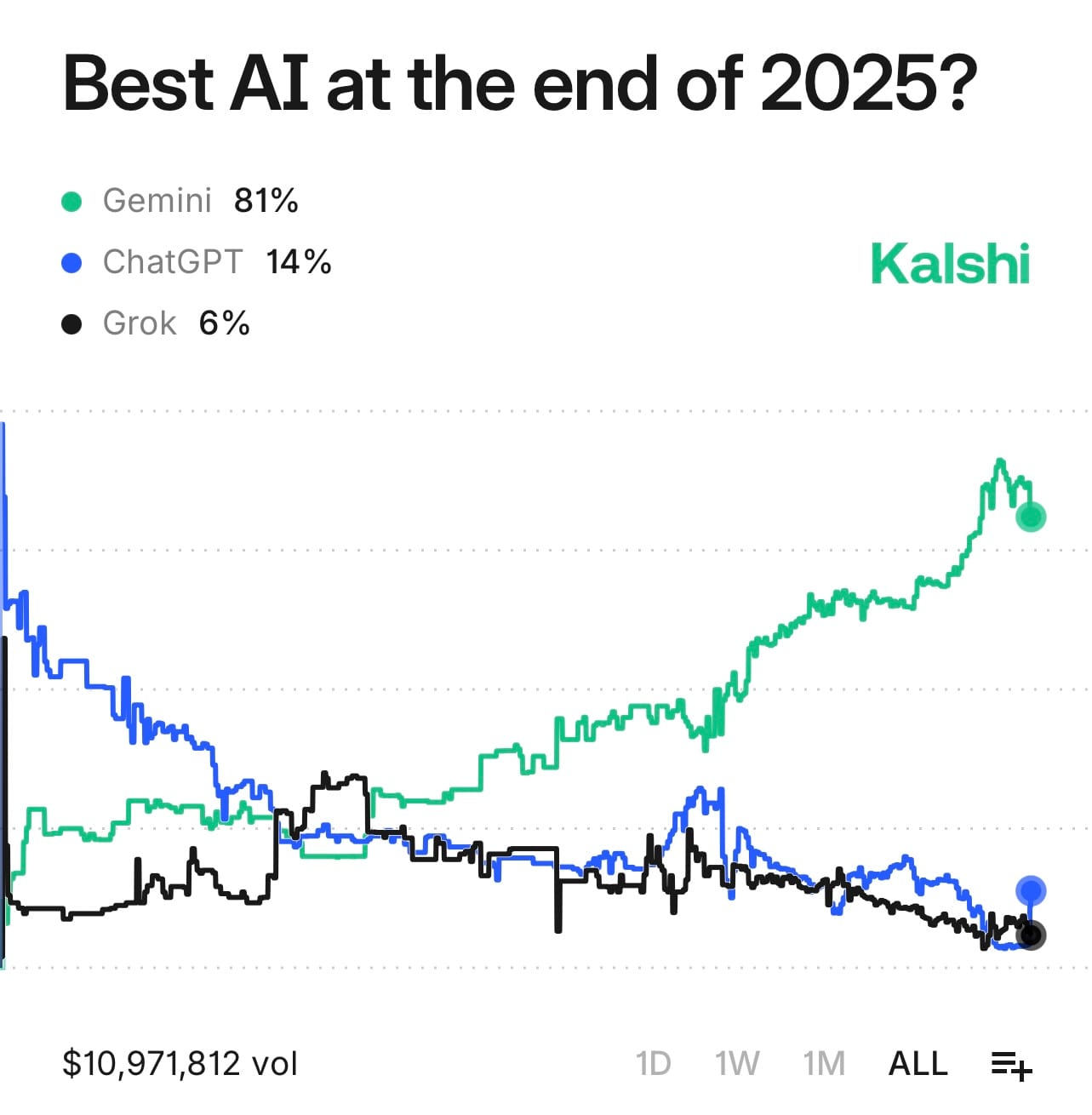
I've noticed this trend for better part of this year: Gemini getting better and better compared to ChatGPT. Now I know it is not just me. And it's not just Futures markets like Kalshi (graphic from this week, above).
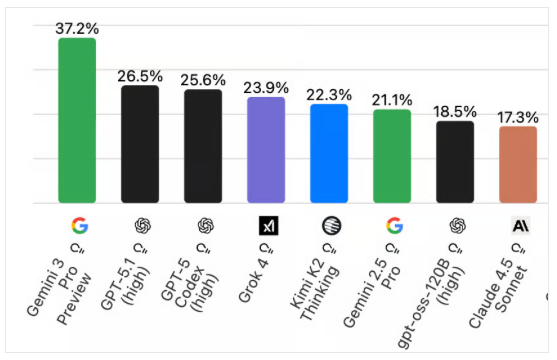
Datacamp shared a range of measures suggestion Gemini 3 has captured the top ranking for the "Humanity's Last Exam" benchmark:
This head to head competitive eval between Gemini 3 and ChatGPT 5.1 across multiple tests (creative writing, multimodal, reasoning etc) declared Gemini 3 the winner on several categories while acknowledging that ChatGPT retains an edge in a few key areas:
- connects to more 3rd party tools
- faster responses for some tasks
- "warmer more conversational output"
Scroll to the bottom of the piece for guidance on which to choose based on your specific use case.
AI Firms are driving up Wikipedia's Operating Costs
AI Firms including OpenAI, Google etc have a common practice of crawling internet repositories like Wikipedia. But this practice drives up server and processing costs for the owners of the internet sites.
Wikipedia is a particularly vulnerable to these additional costs because it has a much wider array of information than say SORA (focused on ornithology) or even ArXiv which focuses on latest research papers / a more limited audience.
To address this growing financial burden, Wikipedia founder Jimmy Wales is engaging the AI firms to secure licensing or use agreements that in effect would offset these disproportionate costs that the AI crawler activities are imposing on Wikipedia.
Couple of actions you can take:
- Share your viewpoint with others
- Share your viewpoint directly with OpenAI, Anthropic, Google and other leading AI firms
- Consider an end of year donation to Wikipedia.
The constraint on the AI arms race: Power not Chips
The real constraint for AI is not chips, its power supply. And China is far better positioned than the US to provide abundant power for its AI industry. Rui Ma's very insightful piece on the US China AI race describes how each nation faces different kinds of constraints.
- "China already produces over 9,000 TWh of electricity annually, more than double U.S. generation"
- "China’s immediate challenge is not lack of power, but how efficiently that power converts into usable compute."
Ma points out that the US's AI needs will require a steep increase in power capacity, whereas China likely already has the capacity it needs. But building new power capacity takes years. In the US, Virginia - the state that imports more energy than another other thanks to its datacenter hubs - has fast tracked solar as an alternative power source. Projects can "move from land use application to commercial operation in 18 to 24 months."
That is much faster than traditional power sources. But solar alone is not likely to make up the gap with China especially in the current political climate where traditional fossil fuels are new fad.
[change leadership learning series]
Making Time to Lead Change Effectively
Did you know that being a change leader puts you at a disadvantage?
- As a change leader you have to learn and execute in unfamiliar territory, and this requires a LOT of time.
- You may also have to operate in 2 worlds, handling near term commitments while driving long-term change initiatives. Both of these factors put you disadvantage - making it harder for you to find the time to do all the things you need to do.
This week's Change Leadership Learning Segment teaches you how to overcome that disadvantage, and gives you a tool that helps you make the time to do what you need to achieve your goals.
Change leaders must learn how to manage their time with above average effectiveness. Learn how to make the time you need to drive change while still meeting your other important commitments.
Ready to start learning? Click here:
- Making Time to Lead Change - Leading change takes extra time - here's a proven way to maximize what you can do with your available time.
- Optional: browse the overview of the full Change Leadership Learning Series.
Opinions expressed are those of the individuals and do not reflect the official positions of companies or organizations those individuals may be affiliated with. Not financial, investment or legal advice, and no offers for securities or investment opportunities are intended. Mentions should not be construed as endorsements. Authors or guests may hold assets discussed or may have interests in companies mentioned.
Member discussion