
Is the world just one black swan event after the other?

The tech and economic drivers of anxiety
Guess what was the fastest growing company last year?
Grow Therapy - a platform that helps people find a therapist - was ranked #1 on the Financial Times 2026 "Fastest Growing Companies" with a 455% compound annual growth rate (CAGR). As Ellen Blix notes here "demand for mental health services is structurally outpacing supply."
Is there any better proof that people are stressed?
There’s just been this constant “alarm” mode… across podcasts, social media, news. Algorithm driven tech platforms make everything feel urgent, like it's at a breaking point, or a point of no return. People just get worn down by that. Exhausted. But is that really the case? One black swan event after the other?
Black Swans in huge flocks?
David Canellis - who recently took over from NLW at the Breakdown podcast - pointed this out from a different angle - just how doom-triggered society has become. If you have a minute, listen to the segment on a new Polymarket Trading Bot that trades No on every prediction (this Breakdown episode - start at 9:34). It's called the "Nothing Ever Happens" Bot.
(Quick explainer: Polymarket runs a prediction market that allows you to bet on a range of things from sports, to economic or political events or outcomes. My mention of it here is not intended as an endorsement of online gambling - as you'll see....)
This "Nothing Ever Happens" bot bets "No" on every non-sports prediction...so questions like "will there be a nuclear attack", or "will AI destroy all jobs by Christmas" etc. all the typical morbid doomsday questions. This automatic trading bot just bets "Nope won't happen."
The bot was developed by former Apple researcher Sterling Crispin after noticing that 73.4% of Polymarket non-sports predictions always resolve to NO!
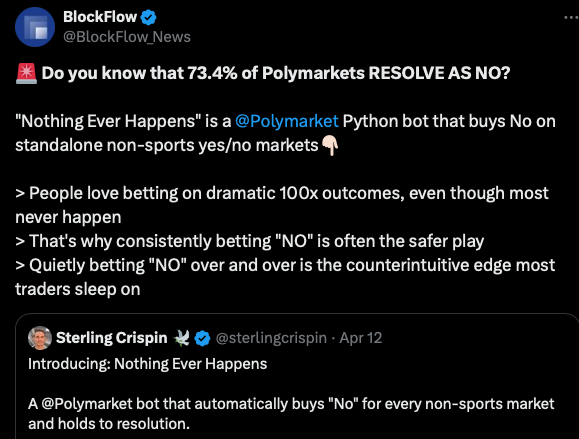
Think about that...3/4 of the predictions didn't happen. The people who gambled that it would happen were wrong most of the time.
In other words, even in a structured market where people are able to articulate their worries with enough conviction to bet money on them, even then it turns out that the vast majority of these outcomes don't materialize.
I think we've aways suspected we are wired for negativity. Part of our survival mechanisms. Our brains are wired to notice threats, and interpret early signals as possible threats, but this adds some interesting new math.
Personally I avoid online gambling. But this is an interesting illustration of the choice we have in our outlook. In your daily focus, when you look out at the possible outcomes are you betting yes or no?
Your answer may depend on what you're doing with your phone...
2 Worlds: Phone Up vs. Phone Down
Today's tech platforms shape a communication environment (aka your phone) that bombards us with more signals and messages in a day than our previous generations may have received in a month. And these messages overwhelmingly seem designed to trigger anxiety.
Have you noticed the difference between what the world looks like when you're scrolling on your phone vs. what it looks like when you put your phone down and interact with people and nature?
Personally, I have.
This week an Uber driver from Eritrea told me America is such a wonderful place because he and his community have been able to build their own community and preserve their own identity here in ways that he doesn't doesn't think would be possible in other countries. He said, "we forget how special this place is." What! I thought America had become an immigrant hating corporate machine forcing everyone to conform to 1950s "values". That's what Facebook tells me.
This is not to say there are no concerns. This is not a call for ignoring the bad things happening. And I don't believe that people want to check out or ignore what’s going on in the world.
It’s more that they’re looking for a different kind of voice. A way to have clarity about what is happening and what is actionable. A calm level-headed voice that's maybe been around long enough to have seen a few cycles—innovation waves, economic shifts, all of that—and can bring a little perspective to it.
Key Point: Algorithms designed for engagement tell us things that keep us engaged...not necessarily things that give us useful insights.
There is an opportunity space for players who are committed to "useful insights" and whose business model doesn't require them to bombard people with alarmism just to drive engagement. This is not a call for blind optimism. Not denial. Just thoughtful. Grounded. Reassuring, with an emphasis on where to focus and what to do.
This is far better than non-stop alarms about crises, but with no clear sense of what to do. It builds up a state of helpless anxiety, which I think is driving the sharp increase in mental health challenges.
But negative messaging is not the only driver. Economic experience - the way people experience the economy is another driver of the high levels of anxiety we are seeing today. Let's dig into that...
The S3T Economic Experience Dashboard
Let's take a few moments to take a look at something we’ve been building on the S3T platform—the Economic Experience Dashboard.
And the reason we built it is pretty simple.
A lot of the numbers you see in headlines—the big economic indicators—don’t always line up with what people are actually experiencing in their day-to-day lives.
You might see a headline that says GDP is growing by a certain percentage, and on paper, that sounds like things are going well. But then you look at how families are actually living, and it doesn’t feel that way at all. In fact, for a lot of people, it feels like things are getting tighter, not easier.
And part of the issue is how we measure the economy.
Over time, a lot of the metrics used by governments and financial systems have become very… averaged. They smooth everything out across the entire system. And when you do that, you can miss what’s happening in specific groups—especially families and individuals who might not be seeing any of that growth in their own income or savings. In some cases, they’re experiencing the exact opposite.
And those experiences don’t always show up in the headline numbers.
So what we’re trying to do with this dashboard is bring that balance back in. To ask a more grounded question: what is the actual economic experience?
What are individuals and families really dealing with? And where / how could we help?
So we start looking at things side by side. What do wages look like in a region… and how does that compare to real costs—housing, utilities, groceries? What kinds of jobs are actually available?
When you put those pieces together, you start to get a much clearer picture of what’s really going on—not just in theory, but in lived reality.
And that kind of clarity matters.
Because when you track this data over time, it becomes much easier to understand how people are feeling—and even how they’re likely to vote in an election. For example, some election outcomes that seemed surprising on the surface weren’t really surprising at all if you were paying attention to the economic experience data.
It’s not necessarily about one administration doing a “good” or “bad” job. It’s more that the measurements we tend to rely on didn’t fully reflect what people were going through. And when voters feel financially strained or uncertain, they tend to respond in a very consistent way—they look for change. They hit the reset button when they go to the polls.
We’ve seen that pattern more than once - in 2020 and in 2024.
So the takeaway here isn’t that we should stop tracking traditional economic indicators. Those still matter. But they’re not enough on their own.
We also need better ways to understand how the economy is actually being experienced—because at the end of the day, the economy isn’t just numbers running on a system somewhere.
It’s something people live.
It’s whether a family can make ends meet. Whether things feel stable… or not.
And if we want to really understand what’s happening—and what might happen next—that’s the level we need to be paying attention to.
That’s what this dashboard is trying to do. Here's a screenshot and there is a link below.
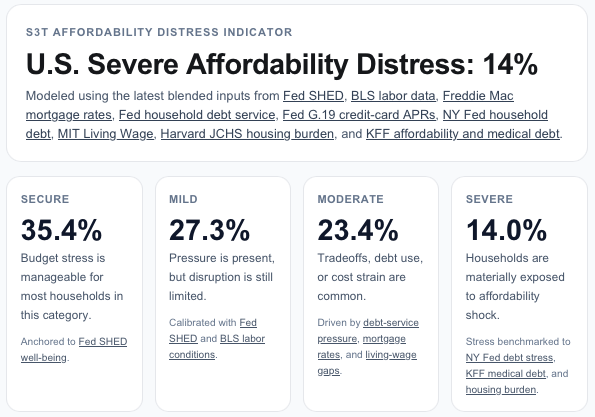
The latest numbers represent a deterioration in economic experience since December 2025.
Below is the link to Economic Experience Dashboard:
 Ralph Perrine
What we can do with this information
I think this part is really important.
Because the Economic Experience Dashboard isn’t just information to look at—it’s something you can actually use. It gives you a way to ground your conversations with elected representatives and policymakers. Instead of speaking in general terms, you can point to real conditions, real gaps between what’s being reported and what people are experiencing.
But it’s also more personal than that.
It’s about awareness. Just being a little more tuned in to what people around us might be going through. Because there are always going to be moments in people’s lives where things get tight… where making ends meet becomes hard.
And most of us, at some point, have been there ourselves. People helped us. Now, we have opportunities to help others.
So part of this is just remembering that—and looking out for each other when those moments come around again, whether it’s for us or for someone else.
By living this way, we’re not just reacting to the economy… we’re shaping something better alongside it. We’re building the kind of community we actually want to live in.
Apple sets records for recycled materials
30% of the materials in Apple products come from recycled content. Even more notable, the following materials used in Apple products come from 100% recycled content:
- cobalt in batteries
- recycled rare earth elements in magnets
- gold plating and tin soldering in printed circuit boards
Learn more at Apple's Environmental Progress Report.
Apple has been struggling lately and is entering a new phase with a new CEO. But in spite of less than ideal circumstances and even less than ideal performance (looking at you Siri) has managed to nail a solid accomplishment for the environment. I like that Apple persisted with this and celebrates this in spite of the recent anti-environment fad which is not aging well.
Related: Azeem Azhar notices that Apple may have more advantages than we realize in the AI race. In a world where economics constrict access to large frontier models, the world's most trusted maker of personal hardware may hold a winning position.
I think there's an encouraging lesson there for all of us. You're not going to be perfect. Perfection & doing the right thing are 2 different things. Perfection is a pursuit. Doing the right thing is a binary choice. Imperfect people and teams when focused on the right things drive the impact that makes the difference.
Have a great weekend, and a great week ahead!
Ralph
Opinions expressed are those of the individuals and do not reflect the official positions of companies or organizations those individuals may be affiliated with. Not financial, investment or legal advice, and no offers for securities or investment opportunities are intended. Mentions should not be construed as endorsements. Authors or guests may hold assets discussed or may have interests in companies mentioned.
Member discussion