AI is changing the work life balance equation

Work-life balance was always complicated for some of us. Today it is for just about everyone.
The changing equation of work-life balance
Work-life balance was always complicated for some of us. Today it's getting more complicated for just about everyone. Think about what we have to do:
- Manage ongoing work as well as the engagement and morale of direct reports, navigating relentless change and uncertainty vs. inertia of lagging org structures and policies.
- Spoonfeed an ever growing host of "AI workers" - Copilot, Claude, ChatGPT and the like - who aside from occasional moments of brilliance, can be pretty hit or miss.
C-suites feel urgency about rearchitecting their orgs into learning machines, but for middle managers its challenging to keep teams highly engaged in a "solve for the mission" mindset while increasing amounts of attention are drawn to AI "team members" that are incapable of having a sense of mission or creative problem solving.
Microsoft's Work Trend Index for 2026 is worth a read, but also illustrates the challenge. It starts with wonderful words scrolling over colorful shapes suggesting great possibilities....
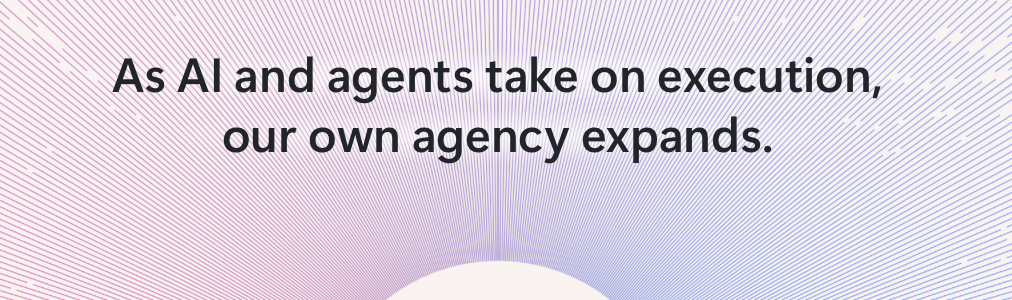
my agency is expanding...ok....
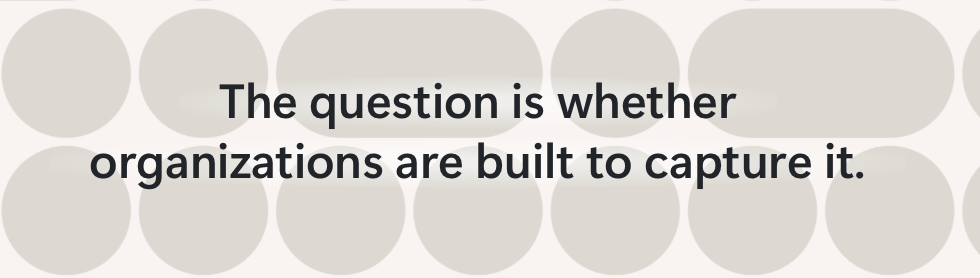
Capture what?
This paragraph clarifies..sort of
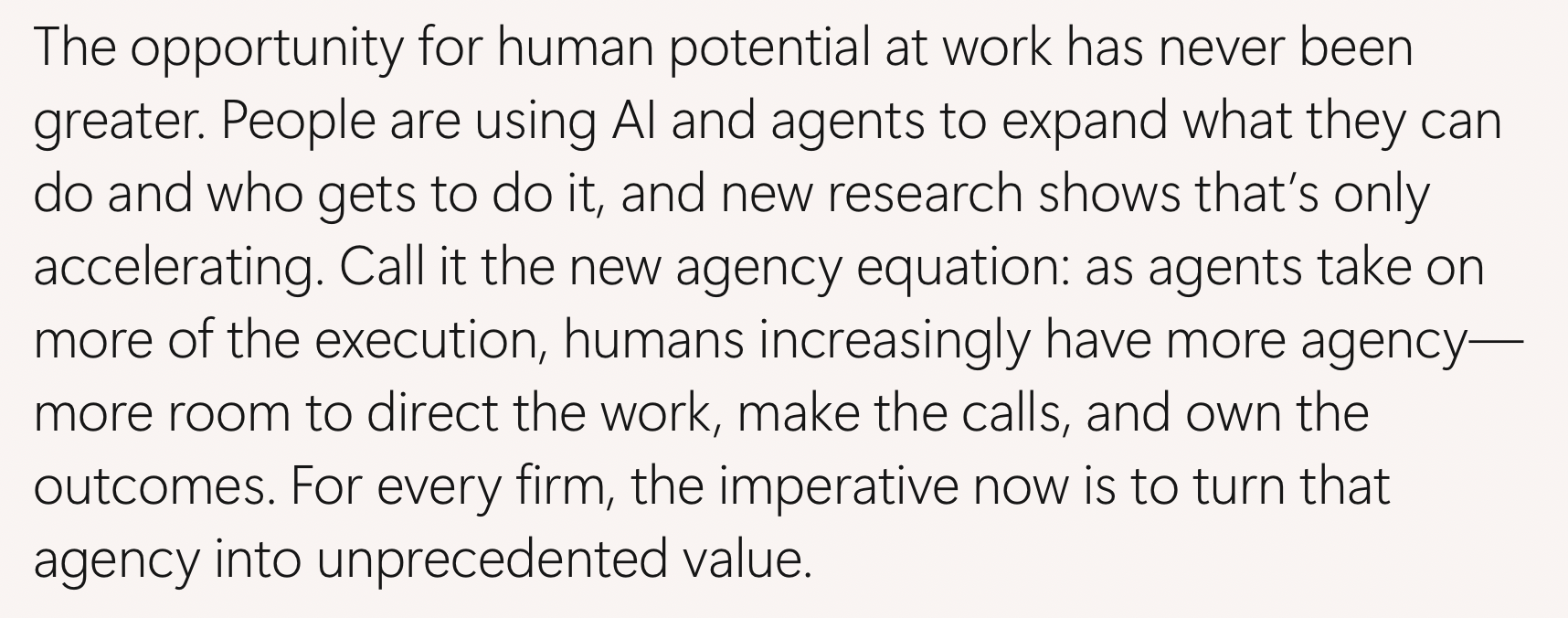
Yes agents are certainly doing more execution. But how much of it is useful - and how much of it needs to be redone? Swept under the rug is the fact that anyone who uses AI agents is now working two jobs:
- Doing the work of your job at your company
- Performing testing and quality control for Microsoft, Anthropic, OpenAI etc. (and ironically we pay them...).
Babysitting agents and sending feedback on their errors takes time. Example from just this week: I ask for a specific technical diagram on a slide. I give it all the details I'd give an architect or engineer.
But what do I get? I get several slides that have a bunch of photos decorated with big fonts that say things like "Technical Diagram" and "Architecture". One slide spells out a generic 3 step process for creating a diagram.
I send feedback to the company that developed this AI Agent.
You might argue this entire loop of work should have been performed by their team, not me.
Even when AI tools work well, there is still a significant time commitment required from the humans using and managing those agents. Microsoft's study uses the term "Frontier Professionals" to describe individuals who are getting the most value from the AI tools. Consider their work patterns:
- 86% treat AI output as a starting point, not the final answer
- 43% intentionally do some work without AI to keep their skills sharp
- 53% pause before starting work to decide what should be done by AI versus a human
In addition they noted quality control of AI output as a significant responsibility.
All of which is making work-life balance a bit more complicated. To be clear this is not to say we should abandon AI tools. But learning how and where to use them effectively does require us to rethink work life balance, and reset our expectations.
It can be especially challenging for those striving to establish their careers and establish financial stability. It certainly was for me in my younger years when I was getting started.

Reflections from my own journey
Many people underestimate the effort required to move from one economic level to another. As a kid, coming from a rural, low-income background, I had no concept of anything beyond manual labor. When I moved to DC, I was fortunate to land an office job, an amazing step for me. To earn more, I took a side job delivering newspapers to all the DC metro stations every night. Each Sun-Fri night I spent 11 PM to 6:30 AM driving around DC, putting papers in the newspaper machines. I'd drive back across the Potomac, changing clothes in restaurant in Springfield, VA, then catch a ride back into DC to start my office job by 8 AM. I worked until 5 PM, went home to rest for a few hours, and then started the cycle again. This lasted for three months. It gave me extra income (I was saving for my wedding) and boosted my confidence in my capacity for hard work.
A few months later I stumbled into a job that placed me at the center of emerging tech, and gave me a sustained opportunity to increase my skills at an accelerated pace. Over the next ~10 years, I worked 100+ hours a week, with frequent all-nighters and occasional 36hr or longer stretches. 5AM to 1AM was a typical day.
The punchline: My economic situation improved, but one afternoon, I drove myself to the ER, thinking the chest pains and breathing difficulty was a heart attack. It wasn't, but the doctors advised immediate lifestyle changes.
Here are the adjustments I made:
- Reconnecting with Art: I made time to draw and paint, rekindling a passion I had set aside due to its perceived low earning potential.
- Financial Literacy: I started focusing more on learning about capital and investing rather than continuing to focus on raw earning power. Even small amounts saved and invested can make a significant difference over time.
- Health: I began running, surfing and working out regularly.
- Being more selective: I started being more selective about what projects and opportunities I engaged with. I learned how to recognize and opt out of situations where I'd have to spend valuable time waiting for management teams to play through their mistakes. I also learned to judge opportunities in light of today's responsibilities vs tomorrow's relevance: will this just bury me in today's responsibilities? Or will it prepare me for tomorrow's relevance?
- Starting to think of a portion of my time as learning time. Time spent working on and learning things that didn't have immediate application, but could in the future.

Factors that played into my journey toward work life balance
- Economic Inequity: Our highly inequitable economic environment means that those in lower economic strata often have to be either extremely lucky or work extremely hard, as I did, to achieve any degree of financial stability. Work life balance isn't really in the cards at that point. My experience happened back in the 1990s, but today I continuously hear from younger people and recent grads facing the same challenge.
- Emerging Technology: Entering the emerging technology sector was a game-changer for me. It's one part of the economy that consistently offers expanding opportunities. Investors and corporate financial stewards are generally more willing to invest in emerging technology due to its potential for increased capability and empowerment, unlike many other professions, whose work is often seen as costs to be downsized.
- Life has chapters. You most likely have the capacity to work insane amounts of hours for some period of time. And you may need to in a specific chapter of your life. If there's a clear opportunity with reasonable assurance of advancing to the next level, it can be worth considering. However, it's crucial to balance this with your overall life and health and a consideration of what chapter of life you are in: I was young and healthy, with no kids or pets. My spouse was also a go getter. Not every chapter of life offers that kind of setting. Later on in my life there were other chapters where I did have kids and was spending significantly more time taking them camping, taking them to doctor appointments, soccer, swim team, Tai Kwon Do etc.
- Share the Skills. Knowing all this should make us want to help each other and share knowledge as much as we can. I had many people who shared knowledge and resources, made introductions, or took time to talk me through things that I didn’t understand. Without them, I would probably be in a very different place today. They didn’t know it but they were giving me crucial stepping stones that helped me learn and move forward in crucial times in my life. If you take a few minutes to stop and help someone or point them in the right direction, you never know how crucial that is for their journey. As we'll see further below...it's not really work-life balance...it's more like work-life-learning balance. The learning aspect is key.
- Share the workloads. As noted above life has chapters where we may be more focused on one thing than something else. In the early phase of my career I had a freedom to work really long hours on multiple projects and ventures. There were phases later where I had to time box my work in more disciplined ways so that I was making time for my family and health. Now that my kids are adults, I have chunks of time available that used to be reserved for after school activities, homework etc. Key point: different people have different capacities for long hours / working after hours / weekends depending on what phase of life they are in.
- If you have the freedom to work insane hours, just know there will come a time when you can’t. You’ll have to learn to use your time more intentionally. And you'll have to rely on others.
- And...be careful of the "some people aren't carrying their weight" kind of thinking. It’s good karma if you help cover for those who are juggling work alongside care for small kids or aging parents. Your time will come and you’ll be glad to have people doing the same for you.
Today's Responsibilities vs Tomorrow's Relevance
For a growing number of professionals, evenings and weekends are no longer just about catching up on work: its more about juggling current responsibilities and tomorrow’s relevance. This means spending extra time learning new agent frameworks and toolkits, experimenting with AI, building small automations...trying to apply them to getting current work done faster better, while preserving focus and staying competitive.
What often gets lost in the excitement is that this process is messy. It involves a lot of trial and error, frustration, and incremental learning. Just realize: the glowing stories you see social media come from heavily funded technology companies where employees may have dedicated time to experiment and fewer day-to-day operational demands. For the average person balancing meetings, deadlines, family obligations, and real-world responsibilities, adopting AI is far less glamorous. It is slow going, riddled with setbacks, and deeply hands-on. And there just isn't enough useful training or mentoring to help you out.
These realities matter: people should give themselves and each other some grace. If your experiments with new tools are not immediately transformative, that does not mean you are behind or incapable. We are all learning to navigate a major shift in how work gets done.

Your takeaways
Its not about work-life balance anymore. It's about work-life-learning balance. And doing it together. Look at your team and partners and colleagues and realize, you're all going thru this together. So help each other learn and get the work done. It makes the load lighter, and makes things more doable.
The Microsoft study mentioned above notes that "organizations are turning into Learning Systems - because the companies that learn the fastest from their own work will be the ones that win." I agree...and it underscores the need to learn as a team.
Different chapters of life demand different tradeoffs, and different people have different capacities at different times. The goal is not perfection and it's certainly not trying to make your work match the hype and buzz in the headlines.
Your and my goal should be steady progress — daily investments in self, family, work, and learning enough to remain capable, healthy, and adaptable while still protecting the relationships, health, and meaning that make the work worthwhile.
Recommended Reading
Microsoft 2026 Work Trend Index Annual Report - shares input from and spotlights the need for firms to build new operating models that enable rapid learning and conversion to value.
HBR's latest on the 4 Day Work Week. This piece argues that more firms should consider a 4 day work week, but reveals half way thru that in practical terms this basically amounts to limiting meetings to 4 days a week and may not truly reduce overall work time required to keep up.
Gallup State of Employee Engagement. Employee engagement continues to decline, especially among managers, as leadership teams fumble org flattening & responsibility scoping.
Opinions expressed are those of the individuals and do not reflect the official positions of companies or organizations those individuals may be affiliated with. Not financial, investment or legal advice, and no offers for securities or investment opportunities are intended. Mentions should not be construed as endorsements. Authors or guests may hold assets discussed or may have interests in companies mentioned.
Member discussion