
Get ready for the age of AI: go into the woods...

They say we are moving towards a new era where systems thinking will be a very critical skill. Agree, but the key question: where do you learn the very best systems thinking?
What is Systems Thinking and Why Now?
Thanks to cloud technologies and software driven supply chains, the world is much more connected and more reliant on collections of systems that are harder and harder to opt out of.
What shows up on your phone, what shows up at your local grocery store all depend on systems comprised of supply chains, data pipelines, financial flows and policy frameworks. In times past, one could choose to be less integrated and less dependent on these systems. That’s harder now.

Today, all of us participate in and are impacted by these systems. In our work, we help design, build, operate or track some part of these systems. We depend on and consume the goods and services these systems produce. So it is more important than ever that these systems be intelligent. Not in the AI buzzword type of way. Intelligent as in smart, effective, resilient. Not sloppy, unreliable and ridden with side effects. In other words better than what we have today. Way better.
- Better than today's brand of social media that drives doomscrolling and depression
- Better than today's technology systems that lock companies into technical debt and make it harder and harder over time for them to stay relevant.
- Better than today's financial systems that divert capital flows into an enchanted welfare state for billionaires while forcing the rest of the world to run on a dried up form of capitalism.
- Better than today's healthcare system that functions as a flywheel for medical debt, physician burnout and poor health outcomes.
- Better than today's economic tracking systems composed of fairly useless averages that seemed designed to keep the comfortable comforted and the uncomfortable quiet.
We could keep going and this could be a very long list.

As the world accelerates, becomes more crowded and complex, the systems we design and depend on will need to step up. This applies to the micro-systems we design and build: applications or business solutions. But it especially applies to the macro-systems we are building: systems that train, power and control AI, global finance and digital currency networks, media & communication platforms, industry supply chains, energy grids, automated transportation systems, and national systems of democratic representation and policymaking.
It also applies to the way we design and build. Consider how the time between initial prototype and mass rollout has contracted:
- A decade or more for airplanes and cars
- Less than 1 year for Generative AI
As time to market shrinks, we lose the "buffer zone" where early-stage failures teach us how to understand and manage the risks factors of a new innovation. We are now in an era of live-fire innovation, where the implementation is the experiment. Under these conditions, the value of any potential innovation has a high likelihood of being severely degraded by unforeseen side effects.
All of this means that human designed systems need to move to a new level of performance that is well beyond the level of today's systems which are -and it's important to acknowledge this: imposing unacceptable levels of risk, and are not ready to sustain us in the future.
To get to the next level of competency in system design we will need better benchmarks and higher standards to ensure we are creating intelligent systems, and following the most intelligent patterns and the most intelligent sources of insight when we design and build.
Where to learn about high performance systems
This raises the question: Where could we find a collection of highly intelligent systems that we could learn from?
The answer:
You’re actually immersed in one. It is the largest most comprehensive collection of high performance systems in the known universe. It offers a vast library of largely untapped patterns and insights for system designers and builders.

Consider just a few random selections...
- Dragonfly wings and flight mechanisms
- Migratory bird navigation capabilities
- Plant reproductive systems
- Mammalian nervous systems
- The way shells grow
- Photosynthesis
- Coral reefs
...from the endless list of rich sources of expertise for solving design problems and engineering truly elegant systems. Vastly superior to the comparatively clumsy error prone feats of human engineering we may hold in high regard.
The systems of Nature that operate inside the boundaries of our Planet represent the absolute pinnacle of performance and durability. No other system or collection of systems has made so many successful intelligent adjustments, or enabled the surviving and thriving of so many participants. No other system has more harmony and resilience.

When confronted with the poor performance of our own handiwork, we like to blame complexity. Nature is far more complex than anything we've ever designed, yet more functional and resilient than anything we've ever built.
The working mechanisms of nature offer a vast set of things we have barely explored. In The Nature Principle, Richard Louv identifies a "nature deficit disorder" that is impacting human creativity and mental acuity. We have only begun to apply ourselves to understanding nature's systems - and it shows in the flaws that plague our systems.

In the few cases where we have thoughtfully applied lessons from nature, the results have been powerful. The TCP/IP Architecture that enables the Internet is a decentralized, self-healing communication system that incorporates patterns we see in nature's systems:
- Redundant pathways
- Local decision-making
- Modular evolution.
Notably the Internet was designed to be evolution-ready: its key component types (data, models, interfaces, governance) are organized in separate layers that allow each to adapt and evolve independently.
This should give us hope.

If we are willing to reset our expectations, redefine what "good" means, and level up - we can study nature more seriously and learn to design and sustain systems that support a level of living and thriving far above what we have been able to do so far. This means going beyond the traditional way we've organized learning:
- Engineering = learn how humans have designed and built things so you can create something that humans can depend on!
- Biology = learn how humans have cataloged what they've explored in nature so you can recite fascinating facts about nature!
Instead, it should be more like:
- Shift our mindsets to see Nature as a collection of systems that provide services rather than simply a basket of commodities waiting to the plundered.
- Learn how nature solves problems and sustains systems based on resilient solutions and services over time, and does so in spite of constantly changing conditions and challenges.
- Update our inventories of design patterns to include a more complete coverage of the system design patterns used in Nature.
- Use this understanding of Nature's patterns to attain a higher degree of proficiency in creating systems that enable human thriving in the 21st century.
Let's broaden our horizons so we study not just how humans have managed risk and solved design challenges, but also how Nature has been solving bigger more complex problems for eons.

A lesson from Hawaii
Olin Lagon offers a powerful example of how humans can learn from and work with Nature. A thoughtful entrepreneur who blends technical insight with a deep respect for nature’s resilience and the inherited wisdom of prior generations, Olin noticed something key in the wake of the recent floods that impacted Hawaii:
“I wish you could all see what I have seen. Amidst all of the devastation from the recent monsoons, the loʻi — traditional Hawaiian irrigated terraces — held. I went this afternoon to weed whack a bit and peek at things. There is almost no evidence this entire area suffered from what certainly was the worst flooding in my lifetime. None of the kalo (taro plants) seem to have been impacted. At all.
Our kūpuna — our ancestors and elders — were so in tune with aloha ʻāina - that deep love and stewardship of the land. These loʻi were everywhere, and they had the capacity to hold billions of gallons of rain in their cell structures. As we paved over loʻi and converted farms to homes and buildings, we lost these buffers. We squandered a priceless inheritance of ancestral intelligence. It is not too late to earn it back!”
Olin's observation offers a glimpse into the ways ancestral generations learned from nature and worked with nature to manage risks far more effectively than we do today.
If you want to be sharp and ready for the age of AI, go into the woods.
If you want to find the cleverest, most durable solutions to the trickiest problems of the 21st century, and most importantly if you want to innovate without creating bigger messes, here is your ace: go study Nature.
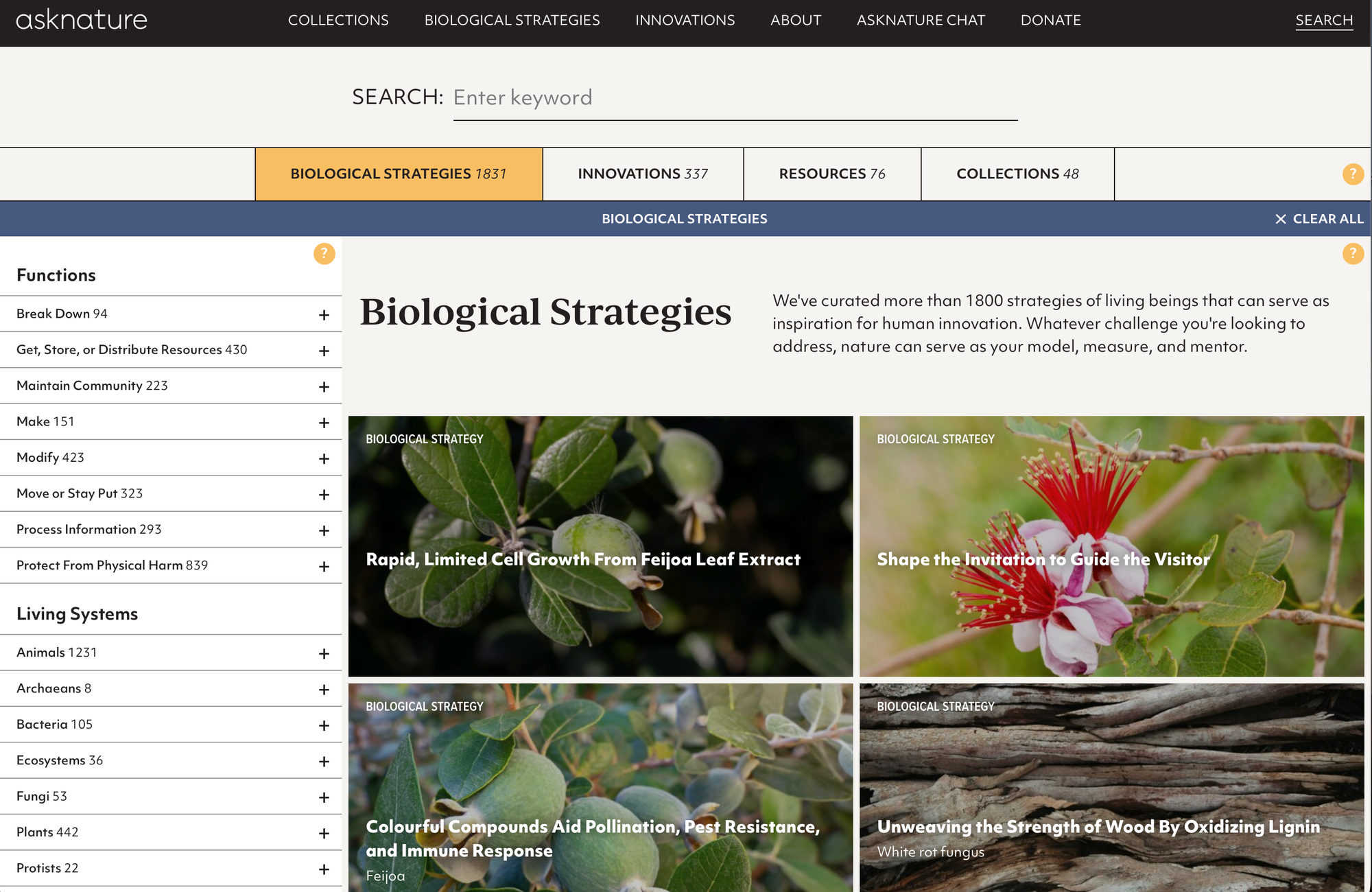
One excellent starting point: AskNature.org curates a catalog of design patterns and strategies found in Nature.
Opinions expressed are those of the individuals and do not reflect the official positions of companies or organizations those individuals may be affiliated with. Not financial, investment or legal advice, and no offers for securities or investment opportunities are intended. Mentions should not be construed as endorsements. Authors or guests may hold assets discussed or may have interests in companies mentioned.
Member discussion