Strategic Skill Building Part 2

It's not enough to translate signals into decisions. You have to translate signals into skills that let you thrive.
Last week we looked at the 5 Layers of Strategic Awareness, a unique world model that helps us recognize signals telling us what kind of changes we should be getting ready for - and how to get ready for those changes.
This week we build on that - with a unique insight about why so many companies fail to adapt and get ready for the future.
Why this matters so much right now
If you track Layoffs.fyi, no one seems immune to layoffs. Amazon, Atlassian, security orgs like Cyberark and Verint, and even AI companies like C3.AI.
Behind these layoffs is a shared, very human desire to prevent layoffs from happening:
- Individuals stress over how to avoid being laid off
- Managers hope their team won't be selected for workforce reductions
Even the most hardened power players have to acknowledge the wastefulness of it all —to invest in people, only to pivot and declare them no longer relevant. It's an admission of failure.
“If I had seen what was coming earlier… if I had helped my team adapt and build the right skills… would we be here?”
That question is being asked right now by:
- the store manager watching foot traffic shift
- the tech leader trying to do more with less
- the SMB executive trying to avoid cuts
- the HR leader racing to reskill teams before it’s too late
If I could have done a better job seeing what was coming, and helping my team adapt to these new changing realities, and build the new skills they need, we wouldn't have been caught in this scenario where we realize we're not ready and we can't sustain the org we've created.
And for those already impacted, there is this sinking realization - whether they can put it into words or not - we saw the signals but we didn't adapt in time.
Right now a lot of organizations are coming to grips with their readiness for the future...and feeling very not ready. In the inevitable rounds of retrospectives, soul searching, and 'how do we not let this happen again', there is something important that gets missed.
Not signal to decision...Signal to skill
Leadership teams tend to think in terms of get good insights --> make a good decision.
This short circuits something crucial.
Making good decisions is a skill not a point in time task. Good decisions are rarely binary coin flips (just pick head or tails).
Not today.
Today's decisions involve tradeoffs, risks of being wrong, hedge factors, assumptions about future events and a plan for monitoring those assumptions, setting visibility thresholds (known future points at which you and the team will gain additional insights), and making adjustments during execution and follow through.
Take a look at today's elements of good decision making:
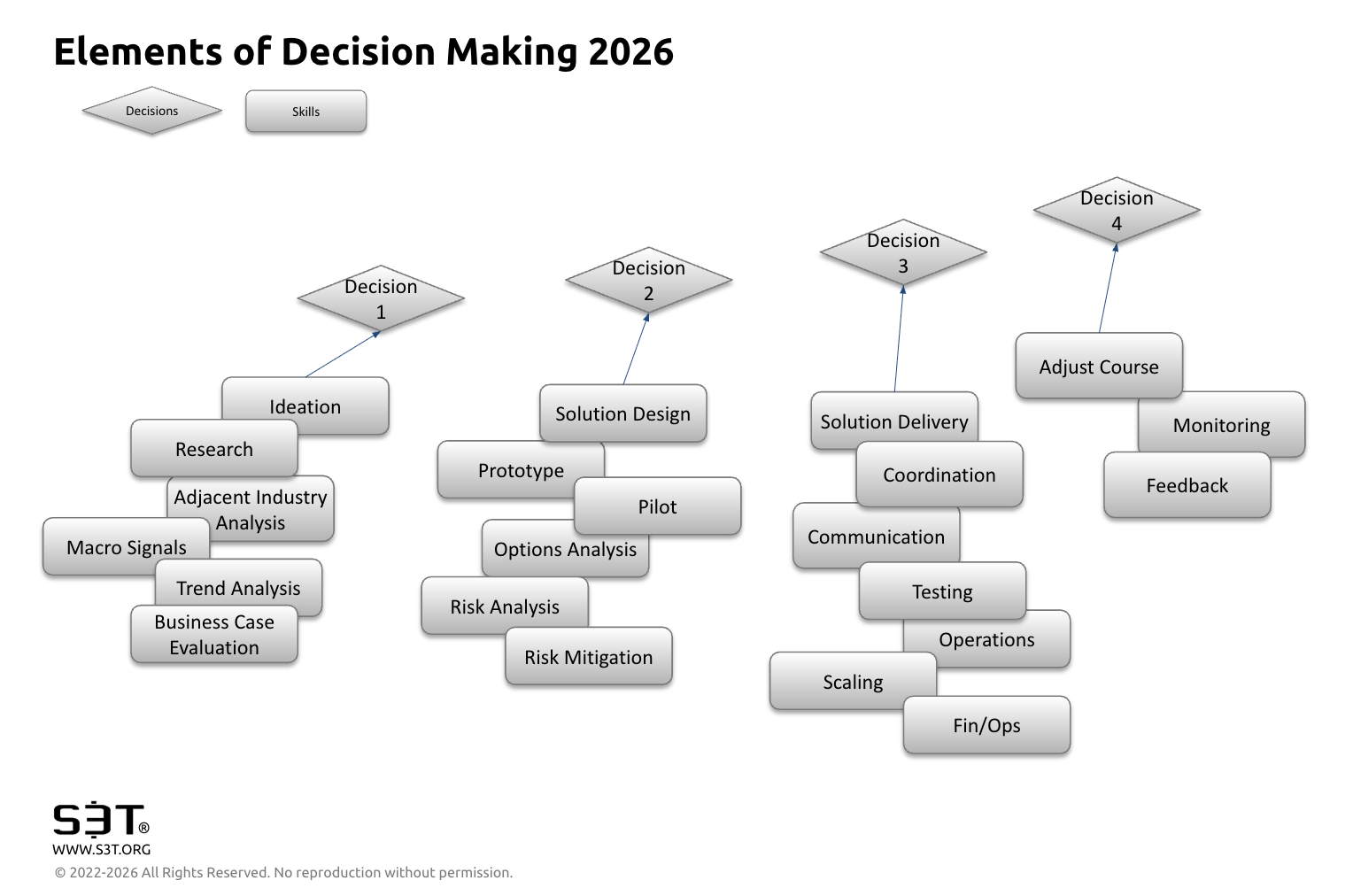
Notice how many of these are all recurring activities vs one time events. Notice how many of them are teamwork activities that require skill. And that they support a succession of decisions, not just point in time coin flips.
You want to be properly aware of your environment. Then you want to respond to that environment in a skillful proactive way
Let's translate this into your organizational context:
- You want your organization to be aware of its environment
- You want your organization to respond to that environment in a skillful coordinated proactive way.
This means you want your organization and all of its parts to be good at recognizing signals about the future, and translating those signals into updated skills and strong teamwork.
It's not enough to bring in a special speaker for a one time event to tell us about the future. Or to read the annual industry outlooks that are published around the beginning of each year.
That's a veneer.
It's one thing to have an organization where a few people have some knowledge of the future. It's another thing for that organization to be actively adapting to the future.
It's literally the difference between a skilled surfer who knows how to adapt to changing wave and weather conditions and still surf with great rides vs. a non-surfer wearing a cool surf hoodie.
This is why we emphasize "signal to skill" not just "signal to decision."
Catching up to do
Many industries haven’t traditionally been very good at providing training or education to help people translate signals into skills. The problem starts at the top.
This PWC chart is telling - both in where it hits and where it misses.
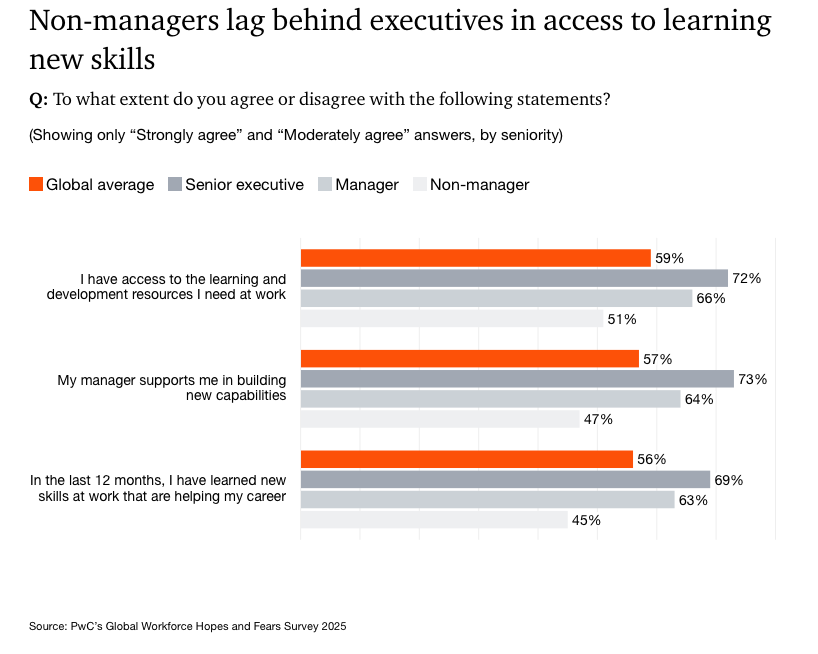
The numbers here ostensibly show a disparity between learning opportunities of execs vs individual contributors.
But this chart actually reveals a more crucial problem:
If 3/4 of execs think they are getting adequate learning, but less than half of their staff are, you have to wonder: are the execs actually getting the right learning? Clearly not.
Why?
It's easy to think about skills in a one-track way. We think of individual learning tracks:
- The technology track: individuals could learn cloud or learn Cybersecurity skills or more recently MCP...technology skills sets based largely on API’s and technical documentation of how to create pieces of software.
- The Org leadership/HR track: teaching people how to have emotional intelligence, executive presence and other clever ways to imply worthiness to be admitted to some rarified inner circle. Sound decision making is too often assumed based one’s relationships, bio, appearance or boardroom behaviors rather than careful evaluation of ones ability to skillfully connect the dots and navigate forward.
There's a large gap between this kind of learning vs. learning how to play a valuable role what organizations have to be today: intelligent decision-making networks, staffed by people who know how to exercise the kind of skills that lead to good decisions.
In our rapidly accelerating world where the stakes seem higher every day, one of the things we really have to do is help upskill people in turning signals into skills. Once we have the right skills we can make the right kind of decisions.
This becomes more obvious when you consider that good decisions (decisions that look good in hindsight) always look good in hindsight because of 2 elements:
- strong due diligence during the decision making process
- strong follow through after the decision is made
This is why we say decision making is a skill - more accurately a set of skills.
So when we look at the set of signals coming from our operating environment, we don't just think "How do I translate these signals into a decision?" but rather how do translate these signals into skills that will help me make good decisions, and drive good execution? We think of signal to skill.
There is a lot more to unpack from here. But now you see the core function of the S3T newsletter and learning platform: picking up on important signals about future opportunities and risks, and then translating those signals into the skills that will give us durable competitive advantages.
Opinions expressed are those of the individuals and do not reflect the official positions of companies or organizations those individuals may be affiliated with. Not financial, investment or legal advice, and no offers for securities or investment opportunities are intended. Mentions should not be construed as endorsements. Authors or guests may hold assets discussed or may have interests in companies mentioned.
Member discussion