
Implementation Paths and the Evolution of Governance
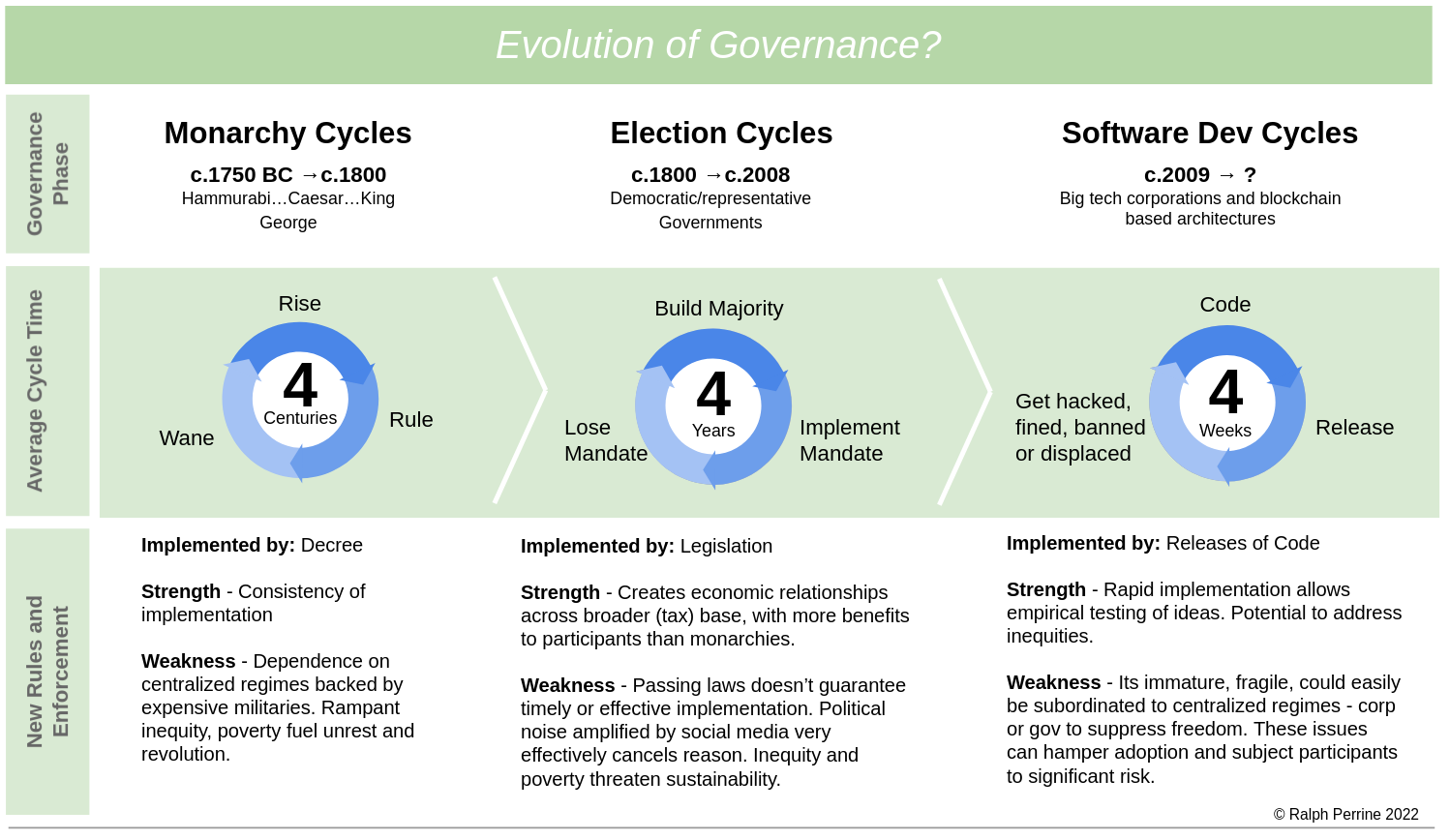
As change leaders, we naturally seek the fastest path rapidly solve the complex and urgent problems of our time.
Learning how to solve a complex problem requires attempts at implementing solutions, learning from the implementation attempts, and iterating or pivoting until the desired outcomes are being achieved.
Given this, it's helpful to know what implementation platforms are available and which ones allow for the most empirical learning in the least amount of time (and money).
Implementation platforms have a direct relationship with governance, and governance is evolving as shown in the featured image above.
Note: we use "governance" here to refer to the kind of control, constraints, rules that exist at the macro level (national, global). This is analogous to the more typical use of the term "governance" in the organizational context - but it exists at a larger scale.
Implementation Path #1: Decree
The world's oldest implementation platform - where a king, religious leader or similar power decrees that something will be built, invaded or enforced - still has relevance today. Authoritarian governments follow this playbook when they do things like ban bitcoin mining, for example. Large transnational companies can also weld this kind of power.
Limitations of this approach:
- It stems from centralized ideation that is narrowly focused on serving the needs of those in power.
- It overlooks or suppresses the needs and human rights of its dependent populations.
- You can't use this option unless you are the one with the power.
Implementation Path #2: Legislation
Typically the first thought of implementation platform is the law. If you want to implement change, write policies and legislation and get them enacted into law. Once the law is passed, think tanks and universities conduct studies reviewing the impact and cost-benefits of the policy, and recommend changes (or often, further study 🙂 ).
Limitations of this approach:
- In spite of representational mechanisms, legislation often does not seem to address the full set of needs and concerns of constituents.
- Political gridlock often prevents meaningful progress. This breeds frustration among the voter base.
Implementation Path #3: Software Release
Today we have a newer, faster way of implementing large solutions (and sometimes large problems): Building an releasing a platform or app - think Facebook, TikTok, Slack and think about the huge influences they have had. Emerging blockchain architectures seem set to push this even further, by combining code, currency and governance into a single programmable layer.
Compare the speed of these platforms
Legislation is the slowest Implementation Path. Consider Healthcare Reform:
- FDR mulled and then abandoned a healthcare agenda,
- Eisenhower briefly floated a National Reinsurance Program,
- Hillary Clinton proposed reforms that were rejected.
- Finally the ACA implemented a set of measures that achieved notable improvements in national coverage, but continue to be debated and questioned by partisan players.
In addition to being the slowest implementation platform, legislation is also - thanks to the partisan bedlam that surrounds any meaningful change - the least likely to allow empirical learning and clear conclusions. Policy does not lead. It lags and gridlocks. Over and over lawmakers struggle to understand the changes being put in motion by technology - whether from the rise of the Internet, or more recently the rise of blockchain based ecosystems.
By contrast consider the rapid rise of software driven transnational corporations like Facebook/Meta and the impactful platforms and new patterns it implemented: from a small group of college students to a collective user base larger than most nations of the world, developing its own currency and demonstrating more soft power and influence than most nations of the world.
Today emerging decentralized blockchain architectures, and the financial ecosystems being built on top of them, show indications of unleashing change in even bigger and faster ways. These architectures do not simply offer building blocks of code - the building blocks are both code and at the same time programmable financial primitives. That's why they represent an evolutionary forward step in governance.
Consider Bitcoin. It has become one of the world's most highly valued investments, yet it has no corporate structure, no employees, never filed for any approvals, and marks the first widely adopted store of value and form of currency that was not created and controlled by a government.
The point is, software releases offer much faster more scalable implementation paths than legislation can. If you are serious about solving the pressing problems in your community, nation or world, your options for faster implementation are getting better all the time.
Full circle" but with a twist
If you go way back, one of the earlier implementation platforms were the decreed charters that European kings granted to shipping companies. The charters granted wide powers enabling these companies to exploit the natural resources of colonized territories, provide increased tax revenues for the crown, and - where possible - employ piracy to interfere with the colonial profit-making of other European nation-states.
The implementation platform that enabled this colonial era was primarily a financial one. The roots of our modern insurance industry derive from this era.
As we stand on the threshold of the next generation financial ecosystem it feels a little like we have come full circle.
But this time, instead of working solely for the health and wealth of a few European kings, we could have a chance to be focused on enabling a healthy wealthy world.
That is exactly what an unsung cohort of founders and builders are working towards. They don't make the daily headlines but they are out there, patiently working. Every day is a new opportunity to be part of that work.
Reflect and prepare to implement in your work
Review questions
First, 3 review questions to test your learning about change leadership:
- What are the three implementation platforms discussed in the text, and what are the key limitations of each?
- How does the speed and effectiveness of software release as an implementation platform compare to legislation, and why is this significant for solving complex problems?
- What historical example is provided to illustrate the evolution of implementation platforms, and how does it connect to modern financial ecosystems like blockchain?
Apply your new lens
What you've learned here gives you a new lens that can bring new ideas and insights when you are planning new companies, initiatives, or products:
#1. Leverage Software-Driven Implementation for Speed and Scalability. When developing new products or initiatives, prioritize solutions that can be implemented through software platforms. Look for opportunities to "force" new ways of working or processing - leverage rapid iteration, scalability, and the ability to gather empirical data quickly and act on it.
#2. Focus on Decentralized and User-Centric Models. Learn from the limitations of centralized approaches (like decrees) and design solutions that empower users and stakeholders. For instance, consider how blockchain ecosystems enable decentralized governance and financial primitives, creating more inclusive and transparent systems. Apply this mindset to your ideation by asking, "How can my solution give power and value back to the end user?"
#3. Iterate and Learn from Feedback. Embrace an iterative approach to problem-solving. Launch minimum viable products (MVPs) or pilot programs, gather feedback, and refine your solution based on real-world data. This aligns with the text’s emphasis on empirical learning and avoids the pitfalls of slow, rigid implementation paths like legislation.
#4. Explore Emerging Technologies and Financial Ecosystems. Stay informed about cutting-edge technologies like blockchain, decentralized finance (DeFi), and programmable financial primitives. Consider how these tools can be integrated into your product or initiative to create innovative, impactful solutions. For example, could your idea benefit from tokenization, smart contracts, or decentralized governance structures?
By applying these tips, you can create faster, more scalable, and user-focused solutions that align with modern implementation platforms and address pressing problems effectively.
Click here to continue go to the next learning segment: The upside of wicked problems
The 21st century has an epidemic of "wicked problems." What approaches offer the best chances of resolving or containing them?