Baked Alaska, UBI, Tax code changes, why its time to define & hire those new AI job roles.

Alaska is already warming at the 2-3x the global average with permafrost thaw damaging critical infrastructure. Ironically its oil-dividend model may be used to rationalize a continued mad rush to overbuild AI energy grids and data centers - and make Alaska's warming even worse. This week's S3T executive briefing reviews the stark choices that change leaders are facing - at the macro policy level and the organizational level. But regardless of how those play out, savvy leaders have a chance to gain first mover advantage for the key talent needed for the next 3-5 years.
3 emerging proposals for addressing potential AI disruption to the workforce
#1. Use AI profits to pay dividends to citizens
Alaska’s oil-dividend model is the hottest new policy idea for cushioning AI disruption to the workforce.
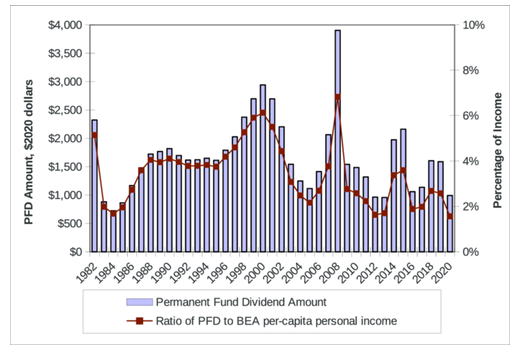
The Alaska Permanent Fund has been providing equal annual payments to Alaska state residents for more than 40 years now. The model is often cited as a template for AI-era “universal dividends” because when it was created in the 1970s it transformed a shared public asset — oil royalties — into a sovereign investment fund that pays annual cash dividends to residents.
The core idea behind adapting this model to AI: if AI becomes a civilization-scale engine of wealth creation, citizens can collectively own a share of its upside through equity stakes, taxes, or an AI sovereign wealth fund that distributes annual payments.
There may be something worth exploring here. But Alaska’s experience also highlights the limitations of this approach: while the fund has been broadly positive, and has lifted some above the poverty line, annual dividends have averaged less than $2,000 per person and have been trending downward.
So let's do some math to reality-check the idea that sharing AI company profits could help offset workforce disruptions and rising unemployment:
- The US individual federal poverty level for 2026 is $15,960/year.
- The Census Bureau’s latest official poverty rate is 10.6%, which means 35.9 million people were below the poverty line as of 2024.
- To simply keep everyone above the poverty line, an AI Universal Basic Income plan would require AI companies to pay out $573B in dividends each year ($15.9K x 35.9M people).
- For reference, the entire SP500 combined paid out dividends of $665B in 2025.
- And - the AI companies to date, are generally NOT yet profitable so they wouldn't actually be contributing to this payout. One AI related company is profitable - NVIDIA - but NVIDIA's 2025 profits of $130.5B would only cover a fraction of the required payout.
- If AI causes unemployment rates to rise even modestly, then this dividend would need to be a lot bigger.
Bottom line - we probably shouldn't be calling this "Universal Basic Income" ....it's more like "annual stimulus check". It could be helpful as a financial buffer, yes, but nowhere close to offsetting widespread unemployment or replace lost wages at a national scale if AI significantly disrupts labor markets.
#2. Change Tax Policy
AI's anticipated impacts to the workforce and economy are also prompting calls for changes to the US Tax Code.
- Vinod Khosla - early OpenAI investor - at a conference in DC proposed a tax code overhaul eliminating income tax on individuals making less than $100,000 a year. Coverage here and here. Predictably Fortune magazine hit back with a "let's not get crazy here" rebuttal.
- Dario Amodei also posted a blog piece proposing higher capital gains taxes to fund universal income: "The key challenge in such a world won’t be incentivizing growth, but finding a way for everyone to share in the benefits."
As noted in the S3T explainer Comparing taxes on individuals vs companies, US Tax policy needed an overhaul even before AI.
But Amodei and Khosla's proposals are some of the more concrete additions to emerging thought on how to cope with AI's radical remake of the workforce expected sometime before 2035.
#3. Just believe in awesomeness
The proposals reviewed so far stand in sharp contrast to the "Age of Abundance" memes floated out of Silicon Valley since 2024. These memes carry a general message of "it's going to be awesome" dressed up in evangelistic prose.
Consider this breathless gem from an A16Z devotional:
"what indeed are the implications for software that can write poetry, listen emphatically, compose music...Consumers will rediscover the latent creativity that lives within all of us. Lacking creative skills will no longer be a barrier to creating art..."
Asking AI to draw you a picture is creating??....So....when you order a burger on the MacDonald's app, you're actually cooking??
Just this week at the launch of Prometheus (a startup that seeks to build an AI engineer) Bezos claimed AI will create a labor shortage and once again reiterated the "golden age" meme.
This is a very shiny brochure, cooked up by people who live in a cocoon and believe they are on their way to becoming super-human. And of course if the reality turns out to be different from the brochure, this won't matter to the cocooned class.
As Zoe Keating put it:
"One of the problems with Silicon Valley is that tech people can't imagine that everything they make isn't totally awesome for everyone else, because they can't imagine scenarios outside their own reality."
Are there scenarios where AI capabilities could empower humans and take us to a new level of universal thriving? Absolutely, but we need to look for independent evidence of this, rather than naively believe the assurances of a group that has been very talented at lobbying and scheming to avoid accountability.
Don't get me wrong. I would LOVE to see a "golden age" for everyone. But it's just important to remember: promises without accountability aren't worth much.
Intentional investments or baked Alaska?
These 3 responses to AI risks present us with a choice: find ways to make intentional investments in our collective well being or just believe a "golden era" is coming and let opportunists turn the world into a hyperscaler heated oven. How ironic if Alaska's oil dividend model is used to rationalize a dismissal of AI's impact to global warming: Alaska is already warming 2-3x the rate of the global average and permafrost thaw is damaging critical infrastructure.
Khosla and Amodei's concepts seek to funnel a portion of AI gains into 3 investment goals:
- Providing basic needs for underemployed groups (which could become a majority of the population),
- Stimulating an artisanal economy where new forms of human creativity and entrepreneurialism become key value drivers - AI empowered humans are freed from working drudgery jobs just to survive.
- Creating wealth funds that give every citizen the ability to own a capital stake in the productivity gains and wealth creation that AI driven manufacturing and automation would be providing at that point.
Even with these kinds of targets, the workforce could go a couple of different directions:
- Not so good: While a few rarified (and who knows -maybe super human!) moguls use their social media platforms to distort markets and elections for profit, the rest of the population will be happily enrolled in a magical Montessori day care being "creative." Said Montessori is dependent on the rarified moguls for funding - and history tells us how well that will go.
- Better: Individuals earn dividends or other forms of income from AI companies, agents, robots etc - ie capital ownership is diffused enough to allow broad financial security derived from AI productivity. Individuals are highly empowered by these technologies and agents to create, build, grow ideas, products, companies more prolifically and powerfully than ever before. In addition they are able to devote generous time to caring for each other and restore/care for nature.
Getting to the 2nd scenario will take a lot of intentional learning, work and investment. The best path forward is to carefully plan with cross-disciplinary teams and heavy engagement with the people who will be impacted. In other words, figure it out together.
Details to watch because they will predict outcomes...
- Payroll tax policy - If AI creates rising unemployment, it will reduce the payroll taxes that fund Social Security thus hastening its collapse - and making it harder for other universal income schemes to work. Worth noting here that Khosla's idea may need additional homework: Payroll Taxes - which finance Social Security - are levied only on wages up to $184,500 ...if no "income tax" also means "no payroll tax" then Social Security's viability could be affected severely.
- Immigration policy - if the current anti-immigration policies continue, they will erode Social Security's viability, per the Social Security's own 2026 Trustees Report.
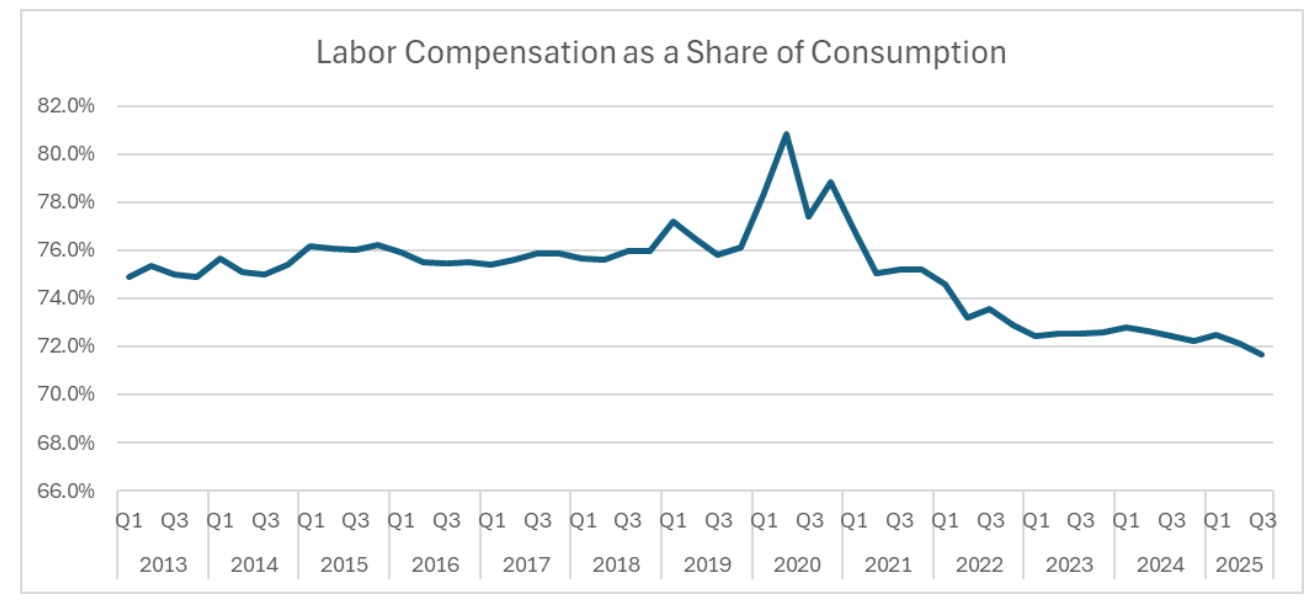
- Labor Compensation as a Share of Consumption - This lesser known metric provides an indicator of the fragility of the economy and risk of a bubble. Since 2021 the metric has been below historical range and declining. Continued decline raises the likelihood of a bubble burst.
Time to define and hire new AI-native jobs
Why we will see more work but fewer jobs
It seems apparent to most that AI/Robots/Automation in general will to change the workforce equation significantly. Sharp increases in unemployment are possible, but there are other possible outcomes too.
Historically, innovations have automated and reduced certain kinds of work, while also enabling - and actually requiring - new forms of work.
Emerging examples already indicate that AI is causing more work - and new kinds of work:
- AI is creating new digital supply chains. Designing, building and maintaining these supply chains will (for some time) require solid engineering talent.
- AI is enabling new kinds of "Mashups" between different categories of technology: Coinbase has rolled out Base MCP a capability that allows your AI agent to connect your Base Account and perform actions on your behalf: track balances, send funds, view transaction history, swap tokens and more. TON Tech’s launch of “Agentic Wallets" offers similar capabilities.
- AI will often impose new requirements for porting systems from old non-AI environments and systems to AI-native platforms and ecosystems.
- AI logistics is likewise a growing category of new work. Mission critical AI requires a lot of support including world models, guardrails and other components that provide guidance to AI agents so they can function reliably in specific business domains, while adhering to the security and compliance requirements of those domains. Models require updates. Robots require maintenance.
- Security and governance is becoming more complicated. AI is difficult to predict and difficult to control. This itself will generate work and jobs. Look at the extra work AI is already generating for security teams.
- Alignment & negotiation: AI brings new capabilities and speed that corporate and government policy structures didn't anticipate and can't govern efficiently or effectively. Likewise corporate org structures and decision-making processes are ill prepared to leverage and get value from AI. There will be high demand for people who can translate/update the intent of old policies into the AI contexts of today, while educating and upskilling security and goverance stakeholders in newer better ways of fulfilling their responsibilities.
Crucial opportunity: define the new AI job roles your company needs - and start hiring ASAP
Calcified corporate org structures and job families may be one of the biggest drivers of the scenario of fewer jobs but way more work. Why? Because companies historically have not been great at recognizing the emergence of new kinds of work, and likewise not quick or good at accurately defining/hiring for new job roles.
SO, companies that want first mover advantage must make it a priority to:
- Identify which of their engineers and staff are working on the front lines of new AI-enabled work
- Engage those engineers in understanding how the work is evolving, and in defining the next generation of job roles
- Quickly define those new jobs and job openings and start filling them before the rest of the market catches on.
Change leaders that focus on this right now will give their teams a first mover advantage that will have lasting value over the next several years.
Opinions expressed are those of the individuals and do not reflect the official positions of companies or organizations those individuals may be affiliated with. Not financial, investment or legal advice, and no offers for securities or investment opportunities are intended. Mentions should not be construed as endorsements. Authors or guests may hold assets discussed or may have interests in companies mentioned.
Member discussion