April Fools jokes or Purpose driven innovation - what are we building?

Tech for techs sake - or for some purpose?
This week on April 1st the Museum of Life and Science posted an April Fool's joke
A "news item" claiming that the children's train ride had been "upgraded" with a high speed train that could race around the museum grounds in only 7 seconds!

For my wife and I, it was a fun reminder of our family memories from years ago when our kids were little - we rode that little train many, many times!
It was also a perfect example of how tech-for-tech's sake innovations sometimes miss the point.
For our kids (and all the others) the whole point of the train ride was to yell and scream when the train went thru the tunnel ... a joyful noise experience that a high speed train would shorten if not eliminate :)
This week we look at the ongoing developments in AI and crypto, and their implications for health and wellbeing of the economy and the people who depend on it. Some of what is happening is tech-for-techs sake, and some of it feels an April Fools joke being played on all of us. Hopefully we are smart enough to see it.
Institutions continue to move into crypto
- Fannie Mae will accept crypto-backed mortgages for the first time: The company is partnering with Coinbase to enable home buyers to use bitcoin or USDC as collateral for their mortgages.
- Franklin Templeton, one of the world's largest asset managers with $1.74T under management, is launching a crypto unit. The new unit is a reincarnation of 250 Digital which FT recently acquired.
and see synergies between crypto and AI
BlackRock’s head of digital assets, Robbie Mitchnick at the Digital Asset Summit in New York last Tuesday:
“AI agents are very unlikely to use, you know, Fedwire and SWIFT…What is crypto? Crypto is computer-native money… AI is computer-native data and intelligence. And so there’s a natural symbiosis there.”
A lesser known crypto player got a coveted shout out from NVIDIA's Jensen Huang this past week:
- Bittensor provides a blockchain based platform for training Large Language Models (LLMs) in a decentralized manner...
- Bittensor trained a respectable 72-billion parameter LLM (Covenant 72B) using a decentralized network of consumer and professional grade GPUs rather than a large datacenter.
- This distributes the energy cost and impact across hundreds / thousands of smaller points.
Huang compared the achievement to the folding@home platform (enables protein folding breakthroughs to fight diseases.)
Bittensor's LLM training milestone offers a glimpse into gentler AI energy strategies for AI model creation, but as we'll see below, big tech continues to drive huge investments hoping to cash in on AI model consumption - billions of individuals paying to use AI models for daily tasks.
but the industry is running out of time to solve quantum security risks
Google resets deadline for Post Quantum Security to 2029 - previous estimates suggested we had a decade or more. This gives companies ~2.5 years to devise and test new security methods that could withstand an attack from a Quantum computer.
The risk to crypto assets including but not limited Bitcoin, Ethereum and Solana should not be ignored, as detailed in this hot off the press technical deep dive into quantum enabled hacking capabilities (must-read for crypto investors, exchanges and CISOs). The research finds that quantum computers will be able to execute hacks with fewer resources than originally thought:
"On superconducting architectures with 10−3 physical error rates and planar connectivity, those circuits can execute in minutes using fewer than half a million physical qubits...we urge all vulnerable cryptocurrency communities to join the migration to PQS without delay"
Bitcoin's recent Taproot upgrade may have made it more vulnerable to quantum attacks. The fact that this upgrade came out when regulated companies are issuing post quantum security roadmaps, suggests the Bitcoin development team still has not developed a coherent strategy for safeguarding Bitcoin from quantum computing attacks.
Meanwhile High hopes for OpenAI...
OpenAI's latest funding deal with Amazon makes it one of the biggest cash burners in history. For context, Silicon Valley ventures in the last 20 years have become increasingly willing to burn huge amounts of investment before finally turning a profit. Their logic: innovation at scale takes patience and a LOT of money.
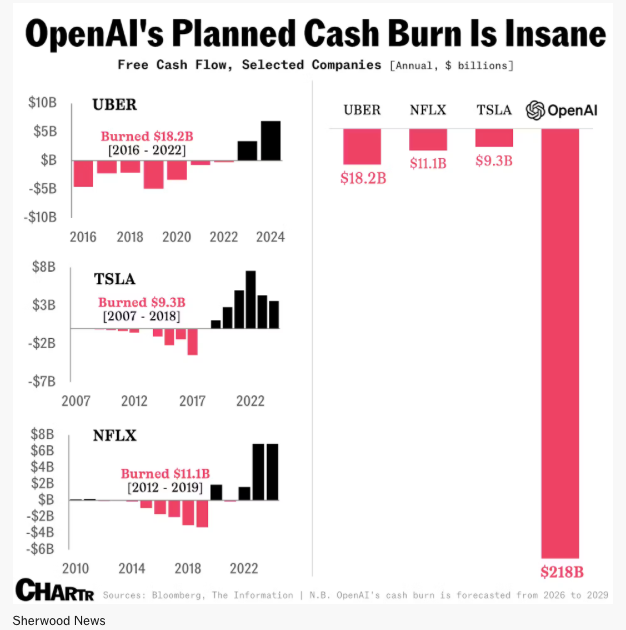
As the chart above shows, OpenAI is taking this to a whole new level. The previous examples of large cash burns (Uber, Tesla, Netflix) seem tiny in comparison.
This is either sacrificial risk-taking to take the world's economy to the next level, or this is the most epic April Fool's joke in history.
Will this massive investment pay off in ways that are net positive?
By 2030, global datacenter capacity will double if trends continue. In recent editions of S3T we talked about how this trend is driving red hot inflation in the supply chains of chips and energy, making it a risky time to lock in multi year contracts for hosting and compute.
But the overheating also extends to the physical world:
- We are now learning that datacenters do increase the local temperatures in their surrounding areas by up more than 9.1c (~48 degrees!)
- These "heat islands" will have impacts on global climate, as well as air quality and quality of life for the people living nearby.
We also continue to get insights on how AI will impact industries and jobs.
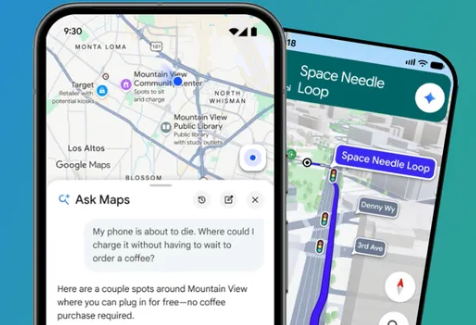
Google Maps new AI driven Ask Maps feature may displace an entire layer of web businesses: review / recommendation sites and booking apps. The new feature allows for much more specific questions: "Where is a quiet coffee shop with charging outlets at each table" or "Is there a nature trail less than a mile off the interstate between Charlotte and Concord." etc.
How to make tech investment work for the entire economy
The long trend indicates very clearly that much of the innovation so far in the 21st century has tended to drive lopsided benefits for the upper end of the wealth spectrum while wages and benefits for the rest remain flat if not declining.
Broadening - and modernizing - capital ownership is an important opportunity for us to explore and act on at all levels:
- Personal level - help the people you know learn how to save and invest, and understand how to use new technologies (and own and operate AI agents and robots)
- Community level - support the creation of small businesses, with a focus on proactively solving the future problems that are emerging today.
- Policy level - adjust tax and incentives to support broader capital ownership
On this last point, policy, Sheila Blair, former chair of the FDIC has a new insightful piece on how exactly US tax and incentive policy needs to be re-tuned for the age of AI.
“the US has long given preferential tax treatment to people who make money from investments over people who earn a living from wages. The unproven rationale for this costly tax break is that it incentivises investment. But as wealth continues to flow disproportionately to investors and away from workers — a trend that AI will probably accelerate — this policy needs a rethink.“
Blair's key insight is that this really isn't about fair treatment for wealthy vs non-wealthy. Its about investors vs wage earners ... for various reasons US tax policy over time has come to vastly favor investors...giving you large numbers of loopholes and provisions for avoiding taxes, while piling tax burdens onto wage earners.
The net net is bad for the entire economy:
- Trillions of dollars are tunneled from one generation to the next without creating jobs or economic growth because wealth holders are incentivized to avoid taxes and risks.
- This is also increasingly understood to be bad for the individuals who hold the wealth: the mental crisis of inheritor's guilt.
An Easter lens on economics...
My Dad was a schoolteacher, and - outside the classroom - a man of few words. But some of his statements really stuck with me.
One time he talked to me about purpose and sacrifice in life. He mentioned the verse where Jesus tells his disciples to take up their cross and follow him (Matthew 16:24).
With these simple words, my Dad encouraged me to live intentionally:
"When Jesus took up his cross, he knew there was no turning back and he was giving his all...You will ultimately spend your life on something. You might as well know what it is."
Which brings us back to the tax and wealth debate:
If we're living without purpose, what good is the money anyway?
Member discussion