A new day: proactive understanding for the shift in value creation

Key signals amid the fog outline the new operating reality
The BLS Inflation report due Friday is widely expected to show another increase. Whatever the number, it won't change the fact that inflation has stayed well above the Federal Reserve's 2% target for 5 years now.
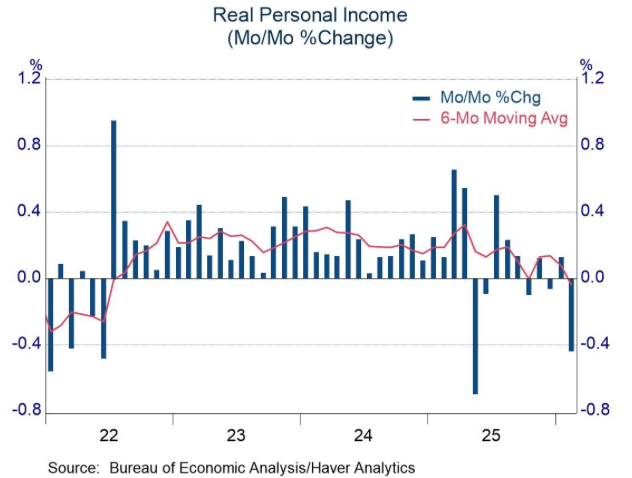
Real Personal Income continues a downward trend along with similar downward trends in consumer spending, and GDP (revised downward to .5%).
If you’re feeling a mix of unease, urgency, opportunity, —you’re reading the environment correctly. We are not in a typical cycle. We are in a shift in how value gets created, controlled, and distributed.
The great repositioning has begun
Among operators, founders, and decision-makers, sentiment has moved into a more focused but uneasy state. (Confusion is slowly giving way to recognition?)
- AI is clearly accelerating—but unevenly
- Opportunity exists—again unevenly
- Traditional advantages feel less durable
Recent data reinforces this shift. The National Federation of Independent Business (NFIB) reports that small business optimism has declined, even as uncertainty has eased slightly—suggesting that people are beginning to understand the environment, but are not yet confident in their position within it.
Repositioning has begun. For proactive teams this means its time to shift gears:
- from: waiting for clarity before acting
- to: adjust in motion. Active systems. So what does that look like for proactive teams?
Let's dig in.
[emerging tech]
AI Security as Active Systems
Databricks just launched a new AI-native security product, Lakewatch, designed to use agents to:
- Detect threats
- Investigate anomalies
- Coordinate responses
These agents are powered by models from Anthropic and are designed to operate continuously—not just when triggered by a user request or by a threat.
BTW: This new capability is based on 2 companies Databricks acquired: Antimatter (secure agent deployment) and SiftD.ai (human-agent collaboration tooling).
So what: Security is no longer a static control layer.
Databricks is just one example of companies moving to address the new operating reality in a world where well funded state actors use AI to wage continuous cyberwar. The 2022 "Defend Forward and Persistent Engagement doctrine by US Cyber Command has now become operating reality for not just the military but all companies. InfoSec has to become a continuously operating, intelligent system that adapts in real time. Why:
- AI increases system complexity
- Static controls cannot keep pace
- Human-only oversight does not scale
Key point for CISOs and AI security teams: The advantage shifts from “who has the strongest controls” to “who has the most adaptive control systems.”
- Treat security as a living system, not a checklist
- Identify where autonomous processes are already acting in your environment
- Design workflows where humans and agents operate together, not separately
Foundational Infrastructure at Risk
Google has updated its estimate for a meaningful quantum computing threat (“Q-Day”) to 2029, way sooner than previously expected.
While most large tech consortiums (The Ethereum Foundation, AWS, Microsoft, and the Federal Gov) are actively developing post-quantum security (PQS) strategies, the Bitcoin community has yet to put forward a clear plan for protecting the network from being hacked by a quantum computer.
This week Bitcoin advocate Nick Carter went on the Bankless podcast with the message "Bitcoin has 3 years to survive the quantum threat" hoping to stoke more urgency that delayed response could expose significant vulnerabilities.
This is a classic cascading shift:
- Physical breakthrough → quantum capability
- Economic impact → existing cryptography becomes vulnerable
- Capital exposure → digital assets and infrastructure at risk
Bitcoin relies on a trust layer (cryptography) that is being obsoleted. Will this informal loose-knit community of anti-authoritarian mavericks muster the resolve to take timely action? Side note: The true identity of Satoshi Nakomoto (Bitcoin's creator) may have been finally revealed thanks to John Carreyrou's quest published in the NYT this week.
What to do
- Understand where your systems or holdings rely on current cryptographic assumptions
- Get clear on which of your platforms and vendors have credible post-quantum roadmaps
- Begin planning for post quantum security transitions, even if timelines remain uncertain
[economics]
Capital Is Being Redirected at Scale
Capital is becoming more centrally directed: At least for now, policy shaping economic outcomes. Markets are reacting to policy, vs policy responding to markets. Recent policy signals from Washington:
- A potential $350 billion increase in defense spending through reconciliation
- Continued support for small business innovation programs
- An ongoing trajectory of rising federal debt
Government is playing a more active role in shaping economic direction.
Instead of relying on central banks levering interest rates, Washington is moving beyond regulation to capital allocation at scale. This will have cascading effects:
- Certain sectors receive sustained tailwinds
- Private investment follows policy direction
- Risk pricing adjusts based on government posture
This reinforces a critical dynamic:
Capital isn't necessarily neutral - flowing to the best business cases, guided by the all wise 'invisible hands' of the free market. In times like these it flows with intent—and that intent reshapes outcomes.
What to do
- Track where public capital is being directed
- Align strategy with policy-supported sectors and initiatives
- Treat regulatory timing and funding flows as strategic signals, not background noise
Growth and Participation Are Diverging
Economists project that AI could:
- Add 1–1.5 percentage points to annual U.S. GDP growth by 2050
- Reduce the workforce by ~10 million jobs
- Push inequality to levels not seen since 1939
How is it possible that GPD goes up while jobs go down? AI increases output—but changes participation. More value is created. But fewer people are directly involved in creating it.
The shifts:
- From doing work → to directing work (work being done increasingly by agents not people)
- From execution → to orchestration
This introduces a new form of competition: Humans and agents operating in the same markets, competing for the same resources. Think about it: If 30 people and 3,000 agents are competing for the same pool of tokens:
- Who gets priority?
- Who sets the terms?
- Who captures the value?
These are no longer abstract questions. They are becoming operational realities.
What to do
- Move toward roles that emphasize judgment, framing, and decision-making
- Develop the ability to direct and evaluate AI-driven work
- Focus on areas where context and synthesis matter more than speed alone.
The Nature of the Firm Is Being Challenged
AI agents are rapidly reducing cost of administrative and operational activities. Will this lead to a Coasean Singularity? The title of this paper is a reference to the original paper of Ronald Coase, The Nature of the Firm which explained that firms exist to reduce transaction costs. Coase was intrigued by the question "if Adam Smith's invisible hand is effective, then why aren't we all freelancers??" (my rough paraphrase). In his paper he answers that question: firms provide economies of scale to handle the transactional workloads that a society of freelancers would otherwise struggle to handle.
The Coasean Singularity paper revisits that question in light of AI agents:
If those costs fall dramatically, will the traditional rationale for large, centralized organizations weakens?
This helps explain several current observations:
- Increasing frustration with silos
- Difficulty maintaining engagement within rigid structures
- High-performing teams operating across boundaries
Organizations are trying to maintain structure in an environment that rewards fluidity. That tension is becoming more visible. And it is likely having an effect on employment.
What to do
- Teach talent to operate across organizational boundaries (be agnostic to the org structure)
- Think in terms of networks and capabilities, not just roles and titles
- Develop workflows that are resilient to structural constraints
To summarize: Periods like this are brief but consequential.
The operating environment is changing along three dimensions:
1. Speed: Decisions, risks, and opportunities are accelerating
2. Structure: Organizations and markets are becoming more fluid
3. Leverage: Advantage is concentrating among those who adapt early
In this window where systems are shifting, structure is fluid, you have a window of opportunity to establish new positions. That window is open now. But it will not remain open indefinitely. To translate this into action this week:
1. Reassess Your Position
- Where are you directly competing with automation?
- Where can you use it to expand your output?
2. Upgrade Your Role
- Shift toward decision-making and orchestration
- Reduce reliance on purely execution-based tasks
3. Follow Capital Signals
- Identify sectors and initiatives receiving sustained investment
- Align efforts with structural tailwinds
4. Expand Your Operating Network
- Build relationships beyond your immediate organization
- Increase your ability to work across boundaries
5. Stay Close to Structural Shifts
- Security
- Infrastructure
- Policy
These are no longer background conditions—they are active drivers of strategy.
See the Full Picture
- 5 Layers of Strategic Awareness" your lens on how real-world signals are interacting across layers—and where to focus next.
- Global Economic Calendar - top 500+ US & Intl real-time economic indicators.
Opinions expressed are those of the individuals and do not reflect the official positions of companies or organizations those individuals may be affiliated with. Not financial, investment or legal advice, and no offers for securities or investment opportunities are intended. Mentions should not be construed as endorsements. Authors or guests may hold assets discussed or may have interests in companies mentioned.
Member discussion