
MCP for the real world, More investment needed not less, Emerging new discipline...

Anthropic's new Model Hardware Standard (MCP for the real world) is one more indication: We are entering a new era where the need for investments - large scale investments - is increasing:
- AI and energy grid buildouts
- Climate resiliency infrastructure (including recovery from climate events)
- Marked increases in defense spending worldwide,
- Aging populations that create gaps in the workforce and overload in healthcare
- Increased requirements for upgrading or migrating systems - to take advantage of new capabilities (Agentic AI, Model Hardware Standard), or to protect against new threats (Rogue AI agents, Post Quantum Security).
All drive the need for - not just increased spend - but increased investment in order to proactively build foundational capabilities and infrastructure to support these needs.
Even if the capital investment is secured, there is also the risk that it won't get spent in a timely manner. Exhibit A: the "logjam" in AI capital spending, as Azhar notes. There is a rising wait time for capital dollars to actually get spent - as construction queues and waits for energy access increase. At stake is a collection of different kinds of investment, including debt levels that sharply increased after 2025.
This is the cumulative effect of accelerated innovation in both finance and technology
We are already familiar with what is happening in AI. But the rapid evolution in AI is also driving new problems and solutions in finance.
- Problems: The new reality of rogue AI Agents is prompting Cyber Insurers to update their policies and the conditions under which they will pay claims. Expect insurers to emerge as a new form of de-facto regulators...no compliance, no coverage. Companies adopting AI need to make sure they don't inadvertently innovate their way into risk territory that their insurers refuse to cover.
- Solutions: In finance for example Coinbase and Better have partnered to create crypto-backed mortgages. The working mechanics of this - two loans, one payment - have broader implications for debt and risk transfer.
This will create a volatile mix of different kinds of risks - higher investment needs, new societal and environmental challenges, new technology buildouts and new financial mechanisms supporting them.
Must go faster......can't
There's something else: the conflict between the need to move faster, but the inability to move faster in the physical and infrastructure and governance layers of the world.
In the past, digital innovation happened with relatively little friction because we were mostly figuring out more efficient ways to move bits and bytes around. Sure maybe it required us to build data centers and lay fiber. But that's nothing compared to the massive physical infrastructure upgrades that innovation is driving today. And the layers of the broader macroeconomy are just not ready to move at this kind of speed.
This is why it is crucial to monitor not just headlines and tech announcements but all of the specific layers of the big picture - starting with the real world physical layer with its scarcity and constraints, then examine the implications of that to capital flows, economics, government policy and societal impacts so we can manage our exposure to these different layers, and increase our chances of discovering crucial opportunities.
S3T Members will recognize immediately that I'm talking of course about the S3T Strategic Awareness Dashboard, which we update each week with the latest early signals from each of the 5 Layers of Strategic Awareness.
Strategic Awareness Dashboard: Watch local & regional conditions vs national.
There has been a long trend of disparity across different US cities, when you compare average work week vs average wage by job titles. In some cities you will work longer hours and make less. In others it's more balanced.
This local variation is starting to become impactful beyond individual jobs.
As noted in the latest S3T Strategic Awareness Dashboard: Over the next five years, expect labor and demand strategy to become local-first: regional employment, youth pathways, skill availability, wages, housing costs, and customer segment will matter more than the national headline economic figures.
Early signals of big change emerge from 5 Layers:
- Layer 1: Physical
- Layer 2: Economic
- Layer 3: Capital
- Layer 4: Political
- Layer 5: Societal
These layers are arranged in order of structural constraint:
- Each layer tends to constrain the layers below it.
- Signals often appear in higher layers first.
- Major tipping points occur when constraints propagate across layers.
Related sets of signals are usually spread across multiple layers. Noticing connections between signals in different layers enables more complete understanding of the timing and impacts of oncoming change, threats and opportunities.
If you want to stay ahead in your career, your investments, and decisions, then this is the discipline for you. This is the highest leverage way that you can spend your focus and energy on learning and building the right skills. This discipline is called change leadership. It's a set of skills that previously have not been taught together, but now need to be.
Tech finance relationships, foresight, execution, skills, collaborative, cross, disciplinary execution.
Where new possibilities emerge:
Innovations that impact the scarcity at the physical layer have the potential to drive huge shifts at the other layers. For example:
- AI is making fossil based energy more scarce, but green energy innovation that taps into abundant energy sources can change the equation.
- The same can be said for innovation that turns deprecated urban spaces, discarded materials and pollutants into mineable resources. Or discovers fungi that can clean up plastic and sunscreen pollution in ocean water.
This week's introduction of Anthropic's Model Hardware Standard (MHS) is another example of an innovation that will change physical and economic possibilities. Anthropic's MHS solves an important bottleneck that has made it difficult and expensive to create coordinated networks of physical devices that follow instructions from any single centralized source let along AI agents.
Claude's Model Hardware Standard: MCP for the real world
This week Anthropic introduced the Model Hardware Standard (MHS), a shared specification that allows AI agents to operate physical devices (cameras, microscopes, robotic arms, conveyers, etc) in a lab or factory and enable communication and reasoning between those devices.
Think of this as the physical world counterpart to Model Context Protocol (MCP):
- MCP provides standard protocol for connecting agents to data and APIs
- MHS provides standard protocol for connecting agents to physical devices.
The standard is being piloted with a limited set of robotics labs and manufacturers.
How MHS solves the integration bottleneck for physical devices
Before MHS, getting different physical devices to work together (for example in a robotic or complex system) required custom software integrations to be created between each individual device or system:
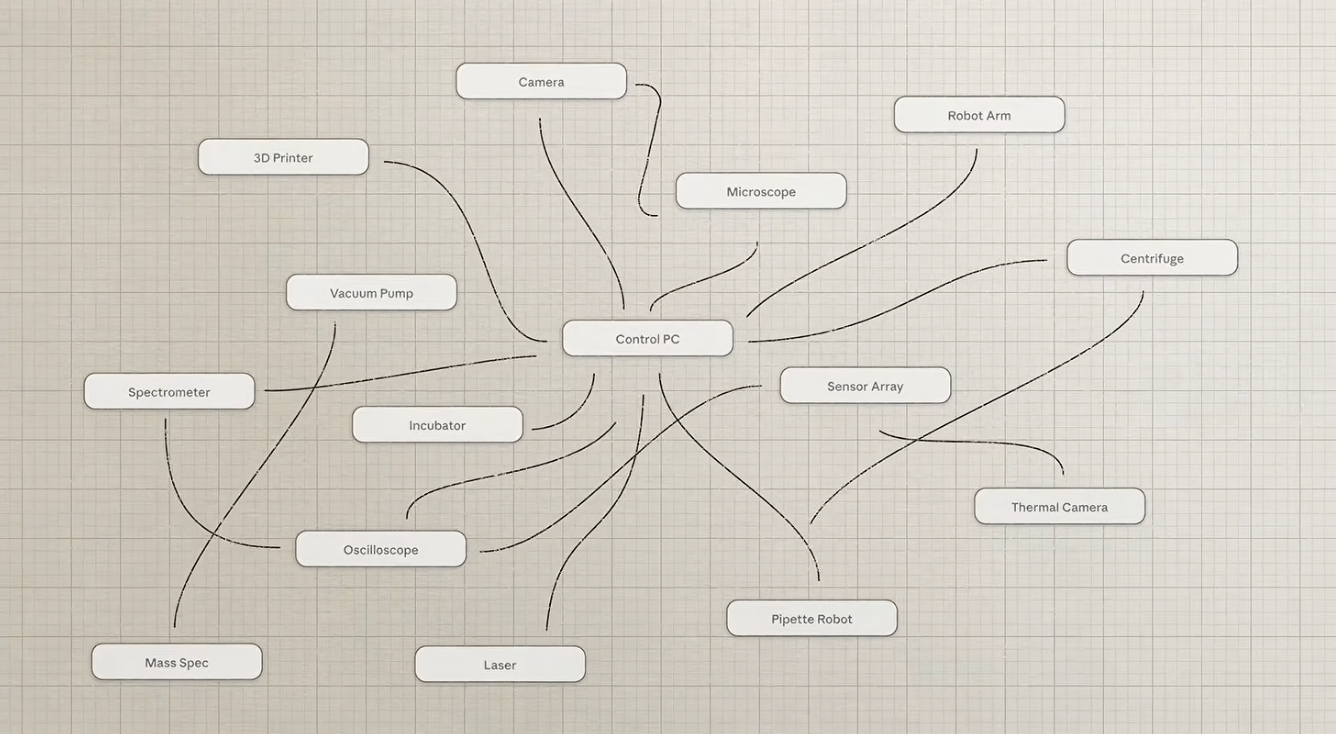
Now, any device that is MHS compatible could be connected to and orchestrated by an AI Agent. The protocol enables one or more agents to orchestrate coordinated actions across the set of devices:
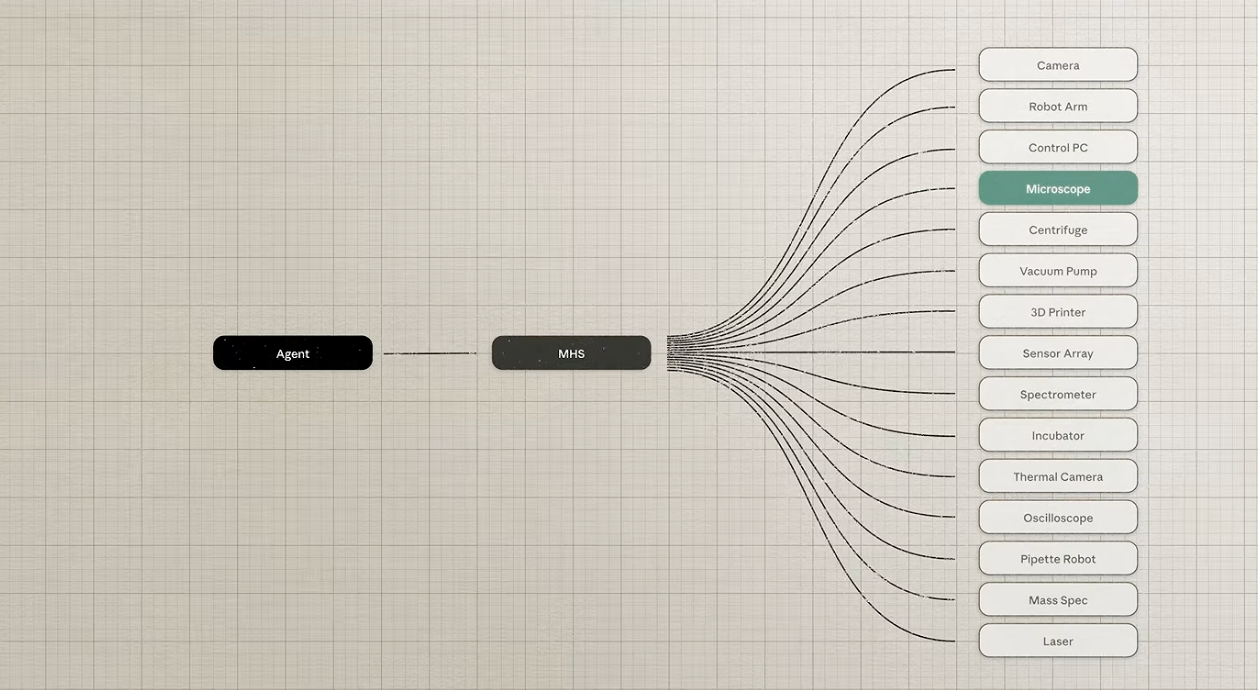
Once implemented at sufficient scale, this removes months of bespoke hardware integration work from the typical robotic system project.
Tentative outlook
How soon might MHS force hardware manufacturers to pivot from selling isolated physical machinery to shipping API-first, MHS-compliant devices or risk rapid market obsolescence?
Notes from Kingly and other sources suggest it will be 3-4 years before widespread Model Hardware Standard (MHS) adoption creates a sharp competitive and operational divide.
For enterprise customers—factories and research labs—this transition requires auditing existing legacy assets to establish deterministic safety boundaries and identify equipment needing API wrappers or physical retrofits.
Over the next four years, will we see buyers increasingly phase out closed, proprietary hardware in favor of "MHS-Ready" infrastructure? We shall see.
Investor signals I will be watching:
- MHS vs incumbent robotics protocols: which will win out? MHS could be complementary to some protocols but directly compete with others.
- Manufacturing sectors: which ones are positioned to quickly adopt MHS vs which ones will require longer timeframes for retooling?
We will do a deeper dive on this in a future segment. But for now, watch the protocols and the adoption rates in manufacturing.
Continue Your Learning
Dig into the S3T Strategic Awareness Dashboard
The S3T 5 Layers of Strategic Awareness framework provides a forward-looking view of early signals shaping technology, markets, capital allocation, governance and public trust.
Change Leadership Learning Series
A new discipline is emerging - and you can become excellent at it. If you do, you're going to be able to further your work and your life in a very big way.
Technology and finance are evolving so rapidly they force corresponding changes in governance, capital flows, economic performance, and society in general, before they have developed usable playbooks and responses to the changes. they're also consuming physical resources in order to drive this change.
Starting Learning about Change Leadership today
Opinions expressed are those of the individuals and do not reflect the official positions of companies or organizations those individuals may be affiliated with. Not financial, investment or legal advice, and no offers for securities or investment opportunities are intended. Mentions should not be construed as endorsements. Authors or guests may hold assets discussed or may have interests in companies mentioned.
(c) 2026 All Rights Reserved. No part of this may be copied or shared without permission.
Member discussion