
Has the field of economics been focused on the right things?

The rise of economically impactful AI is forcing a gut check in the field of economics. What exactly have we been studying all these centuries - and why can't it help us design economies that enable rather than stifle human thriving??

Public frustration with the economy—as seen in the 2024 election and in the recent mid term elections—reflects a deeper structural problem: our dominant economic institutions and success measures of success are not designed to enable broad human thriving.
Headline economic figures like GDP, cost of living, and employment often sound good, but are in reality broad averages that frequently mask deep economic distress. Our economic systems have become extraordinarily sophisticated at organizing capital, managing markets, financing production, and measuring growth. Under the current economic regime, these functions have enabled a few individuals and corporations to gain extreme levels of disproportionate wealth.
At the same time, broader society continues to struggle with fundamental challenges involving affordable healthcare, livable wages, economic security, and community resilience. Runaway technology innovations bring unwanted economic side effects that don't enable human thriving and may threaten the economic security of the majority. While enriching the same few extremely wealthy parties of course.
The sheer lack of clear frameworks for addressing these most fundamental issues of economics begs the question: Have we been focusing on the right things? Research shows that economists themselves perceive differences between what their profession studies and what deserves greater attention. [1, 2]
Why does our understanding of economics seem to have so many blind spots?
Let's take a step back...
Key Drivers of Our Current Economic Blind Spots
The following segments review the drivers that seem to be limiting our ability to define and operate an economy that is better for all rather than just a few.
1. Disproportionate Influence from a Narrow Research Base
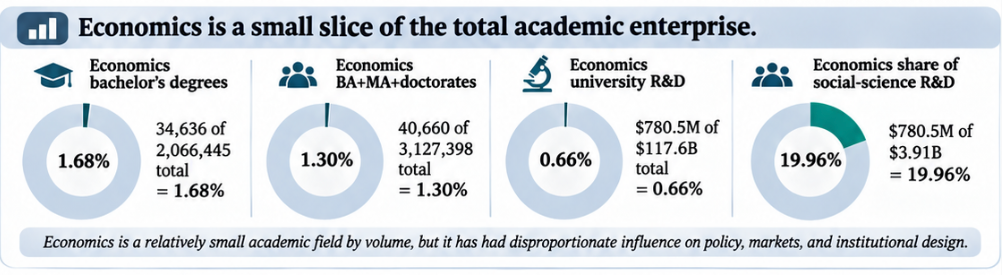
Economics represents a relatively small fraction of the academic enterprise. Consider the size of the economic's field of study in the United States, the seat of the world's largest economy:
- Economics accounted for approximately 1.68% of bachelor's degrees awarded in 2020–21.
- Across bachelor's, master's, and doctoral programs, economics accounted for approximately 1.30% of degrees awarded.
- Economics represented approximately 0.66% of university research and development expenditures in fiscal year 2024, although it constituted roughly 20% of social-science R&D. [3, 4]
In spite of this tiny academic footprint, economics has played an enormous role in shaping fiscal policy, monetary policy, regulation, commercial markets, corporate governance, and public-sector decision-making.
The risk: When the assumptions of an influential discipline become embedded in government policies, corporate incentives, and operating models, the weaknesses in those assumptions will have consequences extending far beyond the discipline itself: They can create the kind of broad economic distortions and perpetuating problems that the electorate is so frustrated with.
2. Reliance on Inherited Theory Without Sufficient Empirical Validation
Many foundational economic concepts—including the ideological traditions associated with capitalism and socialism—took shape when systematic data collection, large-scale computational modeling, and modern causal inference were unavailable. Many of our assumptions about how an economy works were formed when our understanding of economics was rooted more in theory than data backed evidence.
These early theories reflected limitations in data and technology, as well as the political and social assumptions of their time. Yet today they are often treated as principles not to question. The blind application of moral hazard to healthcare is a good example.
In more recent decades, advances in survey and research methods (randomized controlled trials, longitudinal studies), increases in compute power and our ability to aggregate and glean insights from large amounts of data have dramatically expanded our analytical capabilities and improved economists' ability to examine causal relationships.
But this progress has been uneven. Some branches of economics can now evaluate economic experiments with considerable empirical rigor, while others—particularly those concerned with complex systems and long-term outcomes—still draw uncertain conclusions.
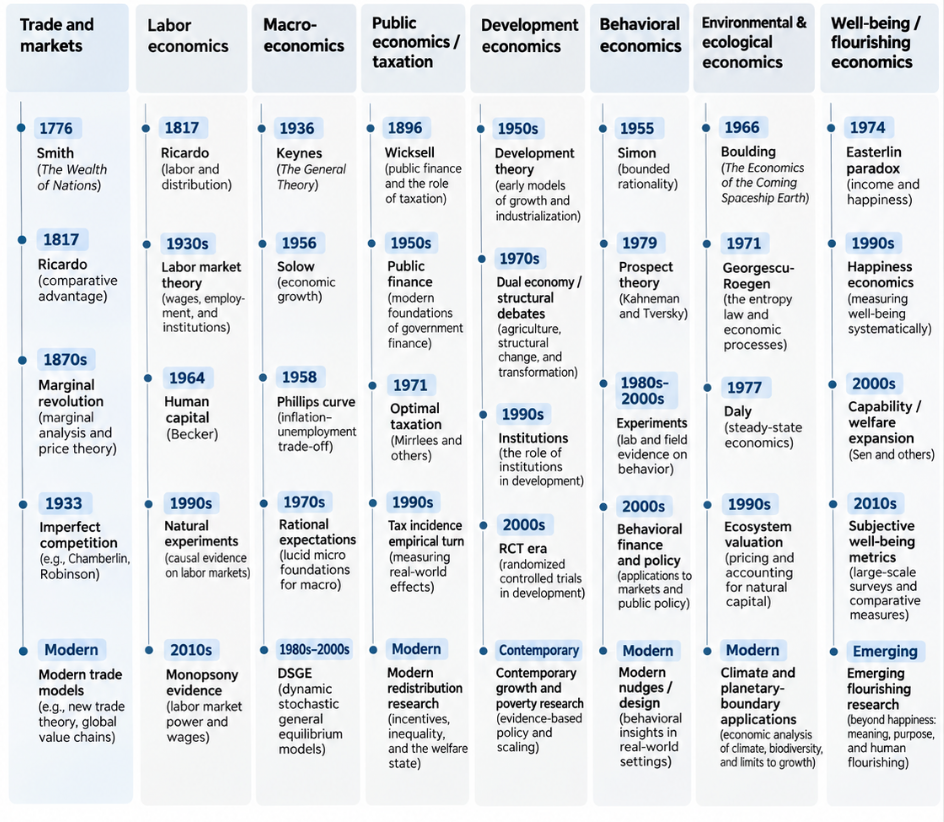
3. Capital-Centric Priorities Versus Human Well-Being
What exactly has our economic research and study been focused on? Economics as a formal area of study has a long tradition:
- Oeconomicus by Xenophon (c. 360 BCE): A Socratic dialogue on estate management and agriculture that coined the term economics (oikonomia), exploring the division of labor, subjective value, and resource allocation (Wikipedia).
- Arthashastra by Kautilya / Chanakya (c. 4th century BCE): An ancient Indian treatise on statecraft and political economy detailing taxation, trade tariffs, price controls, and state-managed enterprise (Wikipedia).
- Summa de arithmetica by Luca Pacioli (1494): A Renaissance mathematical compendium written in Venice that includes the first published description of double-entry bookkeeping, laying the practical foundation for modern financial accounting and business enterprise (Wikipedia).
- Essay on the Nature of Trade in General by Richard Cantillon (1755): Often called "the cradle of political economy," this treatise bridges early modern mercantilism and classical economics by analyzing monetary flows, price formation, and the role of the entrepreneur (Wikipedia)
- The Wealth of Nations by Adam Smith (1776): Published at the dawn of the Industrial Revolution, this foundational work of classical economics examines the division of labor, productivity, free markets, and how self-interest drives broader economic prosperity (Wikipedia).
If you review these, you can't help notice the focus on large estates or monarchies. There is little focus on how to help a community or large group of people thrive. When the topic of human flourishing does come up, it is treated as something that happens automatically if:
- Things are arranged to suit the fortunes of kings and merchants and
- Everyone else stays in their lane and works hard.
The imperative for 21st-century leaders is to move beyond these inherited ideological frameworks and intentionally expand research, investment, and institutional innovation around the economics of human thriving.
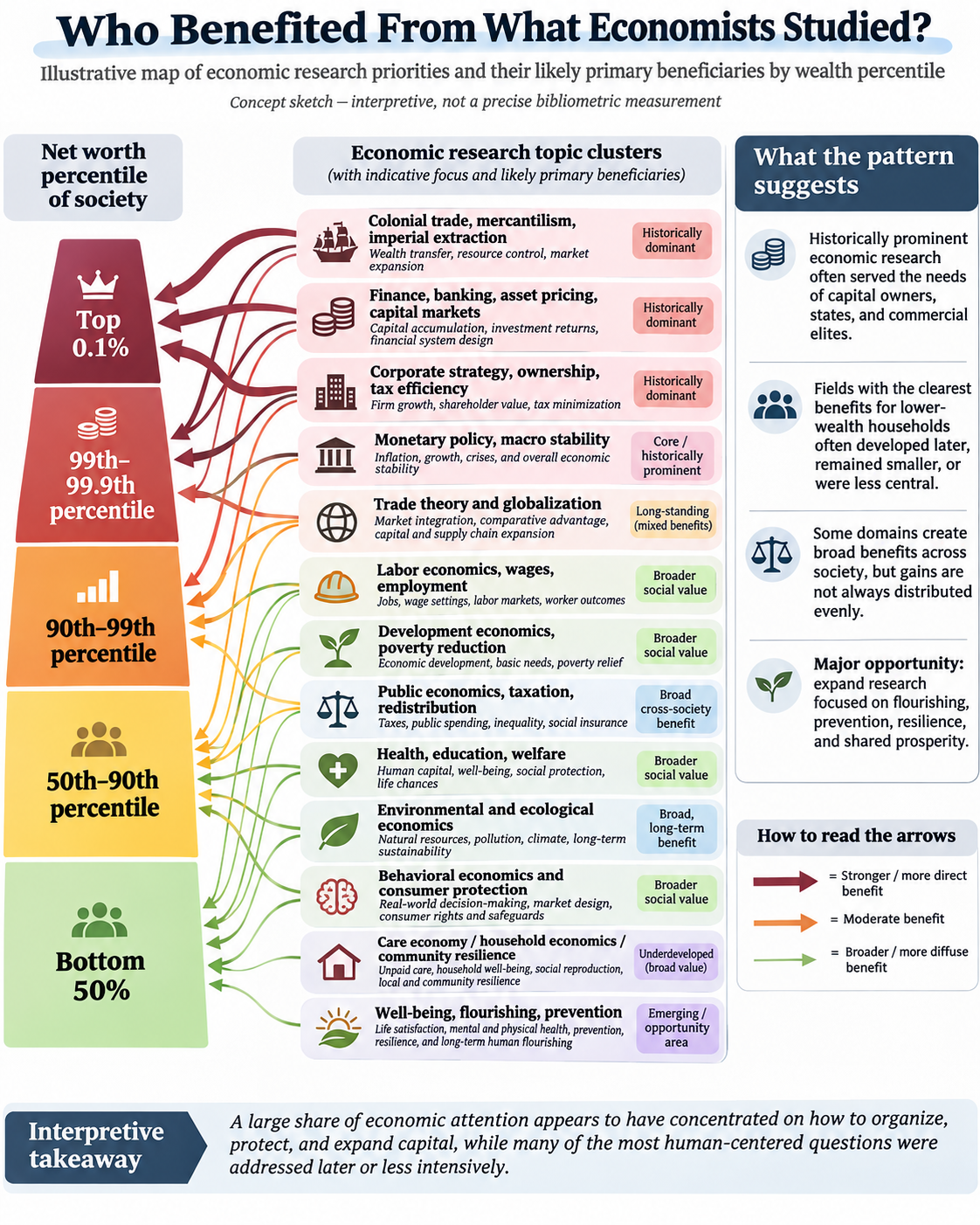
To be clear, we are finally beginning to study the infrastructure of human thriving and the substantial economic costs when we fail establish that infrastructure. But we really are only beginning to scratch the surface here. More study is needed.
Poor health can reduce workforce participation and productivity. Geographic mismatches between employment opportunities and households can undermine mobility. Insufficient prevention and ineffective public investments can generate avoidable future expenditures. Collectively these factors drive conditions where greater portions of GPD rely increasingly on the economic activity of a smaller number of economic players. This in turn leads to volatility in the broader economy.
Conversely, improvements in health, longevity, education, and local economic opportunity can create economic value extending well beyond their immediate costs. The challenge is that in the current economic infrastructure that we run on, the benefits of these investments often accrue to parties other than those responsible for financing them.
This misalignment deserves far greater attention from economics, finance, and institutional design.
Case in Point: Healthcare Distortions
Breakthroughs such as GLP-1 medications illustrate both the opportunities and the challenges of investing in improved human health.
These therapies can produce significant clinical benefits for eligible patients, while sustained treatment, appropriate medical monitoring, and supportive care remain important considerations. Research on treatment discontinuation demonstrates the challenges of maintaining improvements over time. [11]
Yet healthcare financing continues to operate through fragmented contractual relationships, complex payment systems, annual spending cycles, and competing institutional incentives.
Providers are required to manage substantial billing, documentation, and administrative workloads. Patients may face significant financial barriers. Meanwhile, the potential long-term benefits of improved health—including reduced future medical costs, increased economic participation, and better quality of life—may be realized by multiple parties over many years.
This raises a critical economic question:
Why are we so sophisticated at financing and transferring financial risk, yet comparatively limited in our ability to structure investments around sustained improvements in human health?
The problem is not a complete absence of health economics research. Rather, it is the incomplete translation of that knowledge into practical financing mechanisms that align investment, incentives, and long-term human outcomes.
Public health investment research provides evidence that prevention can generate substantial economic returns. The next frontier may be developing institutions capable of financing those improvements while fairly allocating costs, benefits, and risks. [9]
Call to Action: A New Frontier for 21st-Century Economics
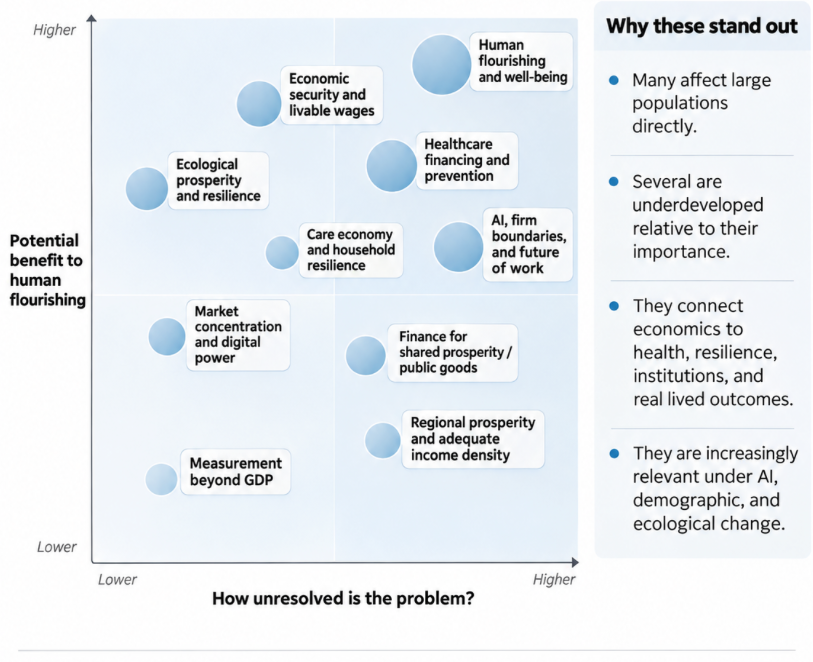
Data science, advanced empirical methods, and AI now let us analyze complex links between health, labor,finance, and community well-being that were once out of reach. Yet analytical power alone won’t improve outcomes—we must deliberately direct it toward the problems that matter most through five priorities:
1. Challenge Inherited Economic Distortions Double check - with the skepticism of an auditor - the assumptions and beliefs we have about how the economy has to work, how healthcare has to work, how markets work, what is high value vs low value. Identify where incentives reward short-term financial gains while shifting long-term costs onto society, and evaluate institutions by whether they create durable, broad-based prosperity—not just financial efficiency.
2. Rebalance Research Funding and Attention Build on traditional economics by expanding rigorous empirical research into high-value, underexplored areas:
- Healthcare financing and preventive investment
- Caregiving, household economics, and community resilience
- Regional labor markets and livable-wage jobs
- AI’s impact on employment, firm structure, and capital ownership
- The economic foundations of sustained human flourishing
3. Develop New Measures of Economic Viability Traditional indicators like GDP and aggregate employment miss whether people can actually thrive—a growing region can still leave many residents unable to afford basic living costs. We need regional metrics linking wages, housing, healthcare, and public infrastructure to distinguish raw economic activity from true economic viability.
4. Build Financial Models That Reward Human Outcomes Create financing mechanisms that share the long-term costs and rewards of multi-institutional investments—such as preventive healthcare or accessible, livable-wage regional development. Grounded in rigorous evaluation of risk, fairness, and legal feasibility, these models should make investing in human thriving financially sustainable without reducing human worth to productivity.
5. Establish a Next-Generation Research Agenda Universities, funders, policymakers, and industry leaders must collaborate to test institutional designs and practical solutions that improve lived outcomes. Start by systematically examining:
- Which questions economics has historically prioritized
- How academic funding and resources have been distributed
- Who has benefited from existing policies and institutions
- Which major problems remain poorly understood or unaddressed
Conclusion: Economics Should Help Us Build Societies That Thrive
The next evolution of economics should be defined by our ability to understand, measure, and improve the conditions that enable people and communities to flourish. We have a chance to use AI and our increased data & analytics capabilities to engineer and design economic infrastructure for human thriving. This will be quite the learning curve. But it will bring the ultimate in value and ROI.
Capital formation, functioning markets, fiscal discipline, and productive enterprises remain essential. But they are means to larger human ends, not substitutes for them.
The central challenge is to apply the same intellectual rigor historically devoted to financial markets, production, and economic efficiency to the health, security, resilience, and opportunities of the people those systems are supposed to serve.
The question for 21st-century leaders is no longer simply how to produce more economic activity. It is how to build economic systems in which more people can genuinely thrive.
Sources and Recommended Reading
The following references support the historical analysis, academic research comparisons, empirical-methodology discussion, and proposed human-thriving research agenda.
A. Economics Research Priorities and Academic Resource Allocation
1. Kelly, M. A., & Bruestle, S. (2011). Trend of Subjects Published in Economics Journals, 1969–2007. Economic Inquiry, 49(3), 658–673.
Examines changes in research-topic shares over four decades, providing direct evidence of how economists' scholarly priorities have evolved.
2. Andre, P., & Falk, A. (2021). What's Worth Knowing? Economists' Opinions about Economics. IZA Discussion Paper 14527.
Surveys economists regarding the objectives and topics their profession should prioritize. Identifies perceived gaps between the existing research agenda and desired research priorities.
3. National Center for Education Statistics (2022). Degrees Conferred by Postsecondary Institutions, by Field of Study, 2020–21. Digest of Education Statistics, Table 318.30.
Primary source for economics degree counts and comparisons with the total academic degree pipeline.
4. National Center for Science and Engineering Statistics (2025). Higher Education Research and Development Survey: Fiscal Year 2024.
Primary source for university R&D expenditures by academic discipline, including economics, social sciences, and total higher-education research.
5. Hamermesh, D. S. (2025). The Demographic and Research Styles of Economics Writing. Working-paper research examining changes in the empirical orientation, methods, and authorship patterns of economics scholarship.
Useful for evaluating the transition from predominantly theoretical research to greater use of original data and experimentation.
6. Bornmann, L., & Wohlrabe, K. (2024). Recent Temporal Dynamics in Economics: Empirical Analyses of Annual Publications in Economic Fields. CESifo Working Paper.
Uses bibliometric methods and JEL classifications to examine differences in publication growth across economics research fields.
B. Human Health, Economic Value, and Prevention
7. Murphy, K. M., & Topel, R. H. (2006). The Value of Health and Longevity. Journal of Political Economy, 114(5), 871–904.
Develops an economic framework for valuing improvements in health and longevity, including benefits not fully captured by conventional economic production measures.
8. Bloom, D. E., Canning, D., & Sevilla, J. (2004). The Effect of Health on Economic Growth: A Production Function Approach. World Development, 32(1), 1–13.
Examines how health contributes to human capital, productivity, and economic growth.
9. Masters, R., et al. (2017). Return on Investment of Public Health Interventions: A Systematic Review. Journal of Epidemiology and Community Health, 71(8), 827–834.
Reviews economic evaluations of public health interventions and the evidence that preventive investments can produce substantial returns.
10. Chetty, R., et al. (2018). The Opportunity Atlas: Mapping the Childhood Roots of Social Mobility. NBER Working Paper 25147.
Uses large-scale linked administrative data to examine how local conditions influence adult economic opportunity, demonstrating the importance of geography and lived economic outcomes.
11. Wilding, J. P. H., et al. (2022). Weight Regain and Cardiometabolic Effects After Withdrawal of Semaglutide: The STEP 1 Trial Extension. Diabetes, Obesity and Metabolism.
Provides evidence on long-term treatment considerations, the maintenance of health improvements, and challenges following GLP-1 medication discontinuation.
C. Regional Prosperity, Employment, and Livable Wages
12. Bartik, T. J. (2020). Using Place-Based Jobs Policies to Help Distressed Communities. Journal of Economic Perspectives, 34(3), 99–127.
Evaluates policies intended to increase employment in distressed communities, including incentives, training, and infrastructure investments.
13. Hanson, G., & Moretti, E. (2025). Where Have All the Good Jobs Gone? Changes in the Geography of Work in the US, 1980–2021. NBER Working Paper 33631.
Examines changes in the geographic distribution of higher-quality employment and the growing differences between regional labor markets.
14. Massachusetts Institute of Technology. Living Wage Calculator: Methodology.
Provides the methodology for estimating location-specific living costs and required earnings under different household circumstances.
15. U.S. Bureau of Labor Statistics. Occupational Employment and Wage Statistics.
Provides occupation-level employment and wage data that can be combined with local living-cost estimates to investigate the availability of livable-wage employment.
16. U.S. Census Bureau. Longitudinal Employer-Household Dynamics (LEHD).
Offers detailed information on commuting, workplace locations, and residential employment patterns, relevant to assessing regional employment accessibility.
D. Economic Distribution, Finance, and Broad-Based Well-Being
17. Demirgüç-Kunt, A., & Levine, R. (2009). Finance and Inequality: Theory and Evidence. NBER Working Paper 15275.
Reviews relationships among financial development, access to economic opportunities, and inequality. Important counterevidence against assuming that financial development benefits only wealthy households.
18. Federal Reserve. Distributional Financial Accounts.
Provides wealth and asset-ownership distributions by household wealth percentile, useful for assessing who owns financial capital and how economic gains may be distributed.
19. Stiglitz, J. E., Fitoussi, J.-P., & Durand, M. (2018). Beyond GDP: Measuring What Counts for Economic and Social Performance. OECD Publishing.
Explores the limitations of GDP as a measure of economic progress and the importance of well-being, inequality, and sustainability indicators.
20. American Economic Association. Journal of Economic Literature (JEL) Classification System.
Provides the standard classification structure for systematically examining research attention across economic disciplines.
Opinions expressed are those of the individuals and do not reflect the official positions of companies or organizations those individuals may be affiliated with. Not financial, investment or legal advice, and no offers for securities or investment opportunities are intended. Mentions should not be construed as endorsements. Authors or guests may hold assets discussed or may have interests in companies mentioned.
(c) 2026 All Rights Reserved. No part of this may be copied or shared without permission.
Member discussion