M364, NVIDIA spies & fixers, AI Overbuild, Resilience Architecture

Adding intelligence to critical infrastructure must not compromise its ability to operate or recover independently. This executive briefing explains what happened, why this is a warning about a key architecture principle that needs to be better understood (and more fully developed to address the risks of intelligent automation), followed by a list of sources and recommended reading.
The Microsoft Outage - Automation in the Critical Path: How Small Failures Become Cascading Outages
This week's global Microsoft outage (still in recovery as of writing) spawned a lot of jokes and memes like "M364" and memes about Google office teams looking on with envy as Microsoft based teams got a "snow day".

The issue appears - based on broad analysis (links below) - to have stemmed from a compounding infrastructure failure where an automated network configuration update caused healthy backend servers to be incorrectly dropped, triggering a catastrophic traffic redistribution failures.
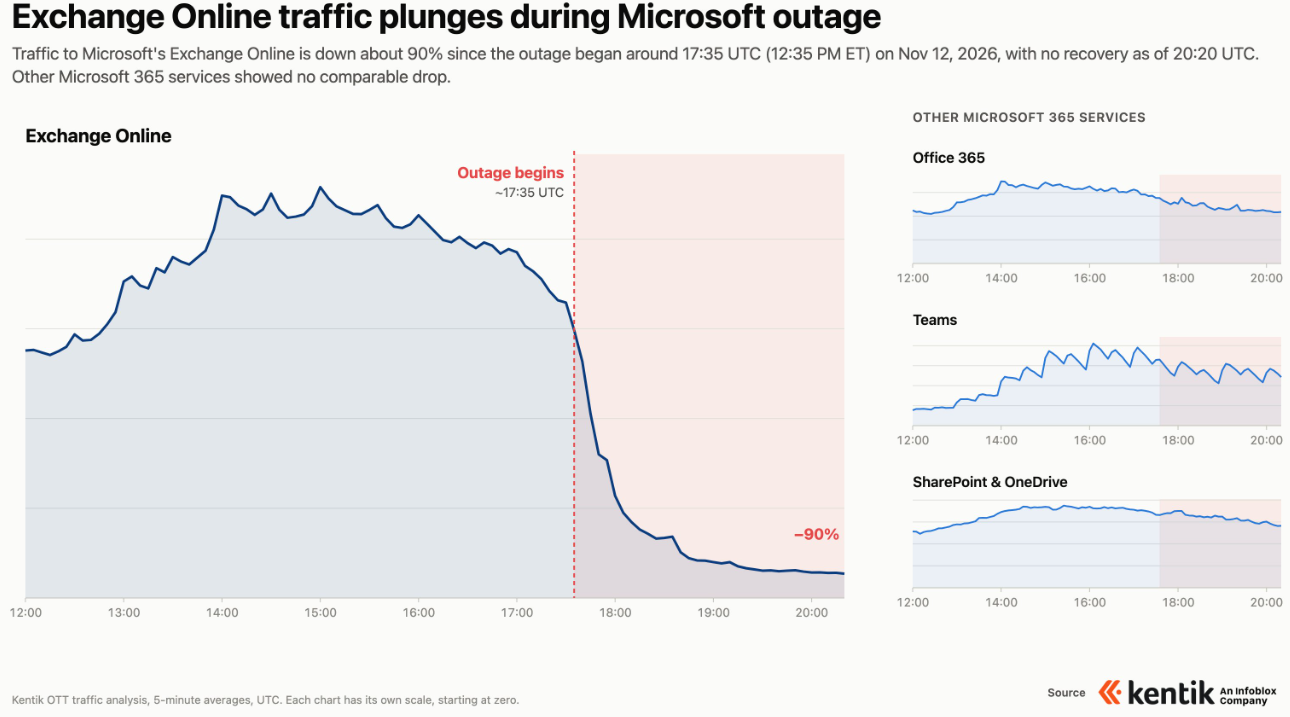
Against a backdrop of recent workforce reductions, and increased reliance on automation and vibecoding, Microsoft's recovery was paralyzed by self-amplifying retry storms and proxy bottlenecks.
Ultimately, the mechanism that locked up the service restoration appeared to be synchronous gatekeepers and proxies timing out under a TLS handshake backlog. This highlights the exact hazard of embedding automation (and soon LLMs or Model Context Protocol dependencies) into critical data paths. In this case, a lightweight secure-connection failure stalled global recovery for over a day.
Imagine the recovery if resource-intensive token-generation loops were in the critical path: it could create an even larger and more complex failure cascade.
Early warning: Resilience Architecture needs to evolve
Which gives us a critical architectural warning: as modern network designs increasingly embed LLMs, MCP gatekeepers, and deep automation directly into core routing, security inspection, and traffic shaping functions, they introduce dangerous dependencies that conflate intelligent control planes with raw data-plane availability.
To avoid falling into these design traps under the banner of corporate efficiency and downsizing, teams need to think in terms of asynchronous decoupling and deterministic failure isolation...a principle of ensuring that intelligence layers can fail open when appropriate or shed load without blocking baseline transport.
This is not easy, and there will be tradeoffs: In regulated environments like healthcare and finance, neither blind "fail open" (which violates HIPAA, PCI-DSS, or fiduciary controls) nor rigid "fail closed" (which halts clinical care or payment clearing) would be acceptable.
This will force to teams to decide in advance how to handle scenarios, and look for feasible ways to execute at the edge: replace real-time central dependencies with locally cached cryptographic state and deterministic fallback tiers so critical transactions remain both secure and uninterrupted when intelligence layers fail.
Cloud architecture teams should set continuous learning paths that focus on resilient distributed systems, cascading failure-domain mapping, backpressure management, and strict circuit-breaker patterns.
Technical Coverage
Official Telemetry & Public Incident Mirrors
- Microsoft Cloud Service Health Status — Official status portal tracking Exchange Online (
EX1550543) and Microsoft 365 (MO1550821) recovery updates. - UPenn PennO365 Mirror of Microsoft Incident Reports — Public mirror preserving the full chronological text of Microsoft's
EX1550543andMO1550821service health updates.
Engineering & Community Analysis (Reddit & Hacker News)
- r/sysadmin: Microsoft's Status Updates So Far, in Order (
EX1550543/MO1550821) — Detailed community breakdown tracing the 11:17 AM ET trigger, failed health-check probes, and the secure-connection bottleneck that caused restarted nodes to lock up under returning traffic. - r/sysadmin: Microsoft Office Outage (
EX1550543) — Servers Dropped Out, Not a Traffic Spike — Early sysadmin thread tracking the cascading failure across Exchange Online, Teams, SharePoint, and Copilot, plus PowerShell Graph API queries for pulling live health status. - r/microsoft365: Microsoft 365 Outage (
EX1550543/MO1550821) Megathread — Enterprise admin discussion tracking regional recovery setbacks, traffic throttling, and service dependencies. - Hacker News: Service Degradation on Microsoft 365 — Engineering discussion dissecting
EX1550543andMO1550821, retry-storm mechanics, and distributed systems recovery failures. - r/technology: Microsoft Says Attempts to Fix Global Outage Not Going 'As Expected' — High-traffic thread debating the role of AI-generated code ("vibecoding"), lack of exponential backoff in client retries, and 2026 engineering layoffs.
- r/technology: Massive Microsoft 365 Outage Disrupts Outlook, Teams, Copilot Worldwide — Community discussion on enterprise single-point-of-failure risks and the real-world scope of the disruption.
- r/antiai: Discussion on Microsoft Layoffs and AI-Generated Code — Community debate examining claims linking Microsoft's push toward AI-authored code and staff reductions to infrastructure instability.
- Microsoft 365 Outage Hits 6 Services, Servers Fail (Shattered.io) — Deep-dive technical analysis of the overload, automated health-check feedback loops, and why the secure-connection layer bottleneck stalled recovery.
- Microsoft Deploys Patch to Stabilize Microsoft 365 Outage (Petri) — Coverage of the overwhelmed backend process, traffic throttling, and the upstream authentication and routing patch.
- What the Microsoft 365 Outage Teaches IT Leaders (EmergEdge) — Breakdown of how Exchange Online's failure rippled into Teams, Copilot, Defender, and Purview, plus business continuity lessons.
- Microsoft 365 Outage Disrupts Outlook, Exchange Online and Teams (SecurityWeek) — Coverage of the failed automated server health checks, elevated processor usage, and mitigation workarounds.
- Microsoft Outage: What Went Wrong, and Why Is It Taking So Long to Fix? (El País) — Timeline of the global disruption, corporate workforce context, and EVP Charles Lamanna's statement ruling out a cyberattack.
- Microsoft 365 Outage: When One Vendor Fails, Everything Fails (Wire) — Architectural analysis of the network configuration rollback, lost server capacity, and single-vendor dependency risks.
- Microsoft's 2024 Outage - Thousand Eyes analysis of the November 2024 outage that impacted Microsoft services.
Mainstream Coverage
- Microsoft Cloud Service Health Status — Official status portal tracking Exchange Online (
EX1550543) and Microsoft 365 (MO1550821) recovery updates. - Microsoft 365 Outage Disrupts Outlook, Exchange Online and Teams (SecurityWeek) — Coverage of the failed automated server health checks, elevated processor usage, and mitigation workarounds.
- Microsoft Outage: What Went Wrong, and Why Is It Taking So Long to Fix? (El País) — Timeline of the global disruption, corporate workforce context, and EVP Charles Lamanna's statement ruling out a cyberattack.
- Worldwide Microsoft 365 Outage Disrupts Outlook, SharePoint, Teams, and More (Malwarebytes) — Breakdown of why restored servers repeatedly became unresponsive when traffic returned.
- Microsoft 365 Outage: When One Vendor Fails, Everything Fails (Wire) — Architectural analysis of the network configuration rollback, lost server capacity, and single-vendor dependency risks.
- Outlook, Microsoft 365, Teams and More Down Live Updates (Tom's Guide) — Chronological log of Microsoft's status updates, including the 48-hour email queue protection window.

A Note About NVIDIA - Spies? or Fixers?
Jenson Huang has resigned amid a dominant media narrative about his alleged collusion with a spy. Desmond Shum details a more pragmatic view: Alice Huang was working as a "fixer" not a spy - the aim was to acquire NVIDIA hardware not information per se.
As Shum notes, Alice Huang has had a long career as a commercial "fixer" -someone who makes arrangements on behalf of larger players who prefer to remain unseen. In this role, Huang helped to arrange what was ultimately an illegal workaround of US export controls, routing billions of dollars' worth of restricted Nvidia AI chips to China.
Congress is now investigating whether NVIDIA's large political donations influenced the White House and the Department of Commerce to make exceptions that overlooked the rather obvious, openly available information about Huang's ties. Shum's analysis is worth reading because it illuminates a common but little understood playbook of global finance where sophisticated commercial operators monetize access, regulatory loopholes, and elite cross-border relationships.
Desmond Shum is a former fixer himself as detailed in his 2021 memoir Red Roulette which details how informal networks, personal favors, and family alliances dictate real political and economic power in China (book review here).

The increasingly shaky foundations of the AI Buildout
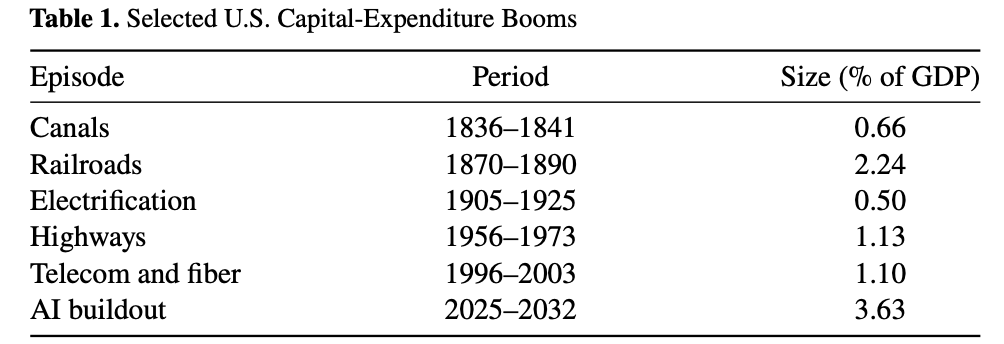
Stijn Van Nieuwerburgh has a new analysis of the AI buildout that sizes the potential risks to the overall economy. The entire analysis is worth a read, but investors, owners, and policy makers should especially take note of several key points.
First, the projected buildout will represent 3.6% of GDP...for reference, this is on average 3x larger than the historical buildouts of railroads, the electrical grid, the highway system and telecommunications.
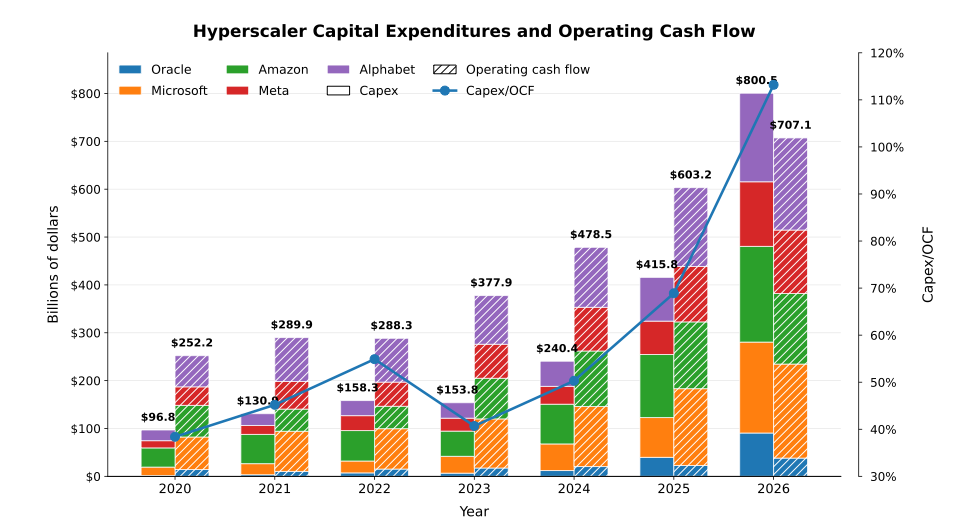
Hyperscalers are outrunning their cash flow...In the chart below, compare the solid colored vertical bars (which represent capital investments in the buildout) vs. the cross-hatched bars which represent operating cash flow:
And the organizational diagram below suggests that at least some are already expecting the worst - or at least understand how risky this actually is:
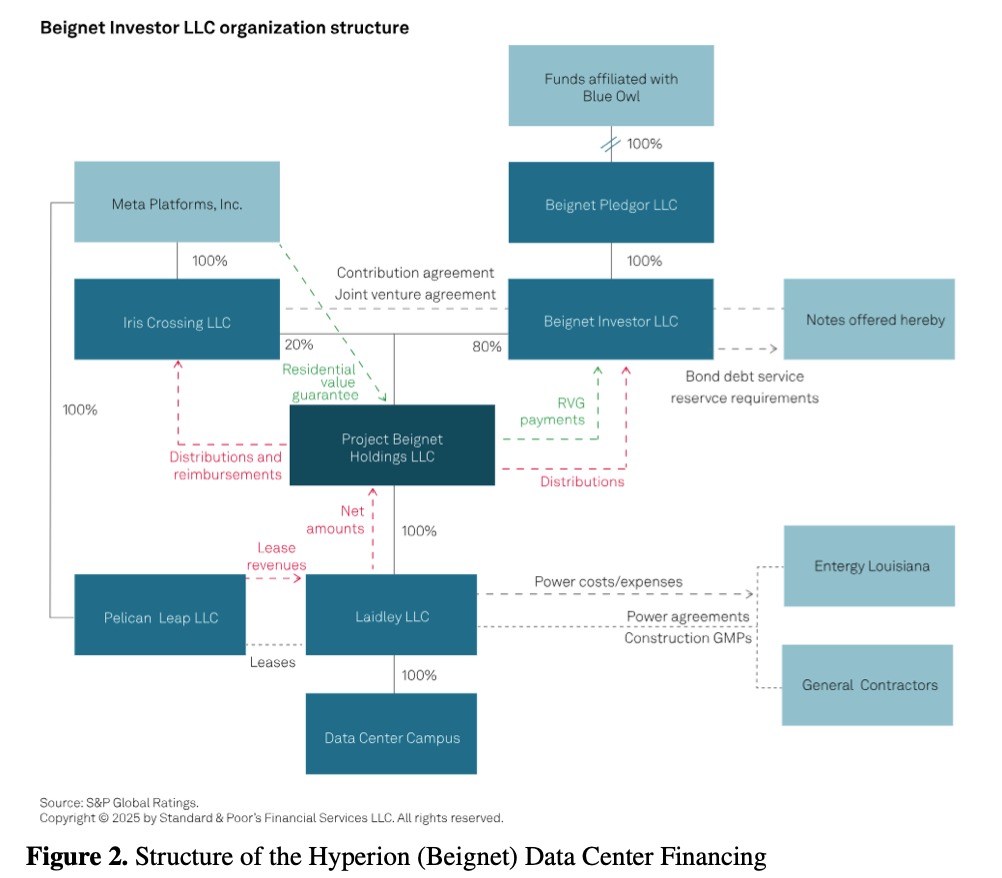
This chart illustrates the layers of protective "firewalls" for investors - each LLC on the chart represents a disposable corporate entity that can be jettisoned, bankrupted, and disposed of in order to limit the financial impacts to larger upstream investors. This of course leaves others in the lurch. Again, at least some people realize how shaky the financial foundations of the AI buildout are becoming.
Resilience Architecture: 3 Takeaways to double down on
1. Cost management of your AI and cloud spend
2. Model Agnostic Architecture
3. Learn how to safely add intelligence to critical infrastructure.
Have a great weekend!
Ralph
Opinions expressed are those of the individuals and do not reflect the official positions of companies or organizations those individuals may be affiliated with. Not financial, investment or legal advice, and no offers for securities or investment opportunities are intended. Mentions should not be construed as endorsements. Authors or guests may hold assets discussed or may have interests in companies mentioned.
(c) 2026 All Rights Reserved. No part of this may be copied or shared without permission.
Member discussion