
How AI will remake workflows - and capital flows

Microsoft’s buyout offer, a new generation of business workflow tools, and how capital flows and corporate structures may shift.
Microsoft’s voluntary separation offer to 60,000 eligible employees - almost a third of its workforce - got a lot of attention this week. While many presumed this was some kind of bellweather of increased AI productivity, Azeem Azar had a different take noting that Microsoft wanted to make this move now because shedding staff later will likely be more regulated and more expensive. I do think he's right about this point, and we'll talk about that in a few minutes.
But then I read Commanding Heights an excellent new essay out this week from Will Manidis and Joe Roberts - two investors who also write about macro. Their thesis is that AI is enabling "abundant intelligence" BUT that the actual benefits of this abundant intelligence are not going to accrue to those who specialize in making frontier models. Models are becoming commodities and in the authors' view, model builders will fail to capture value that is proportional to the massive capital investments being made today.
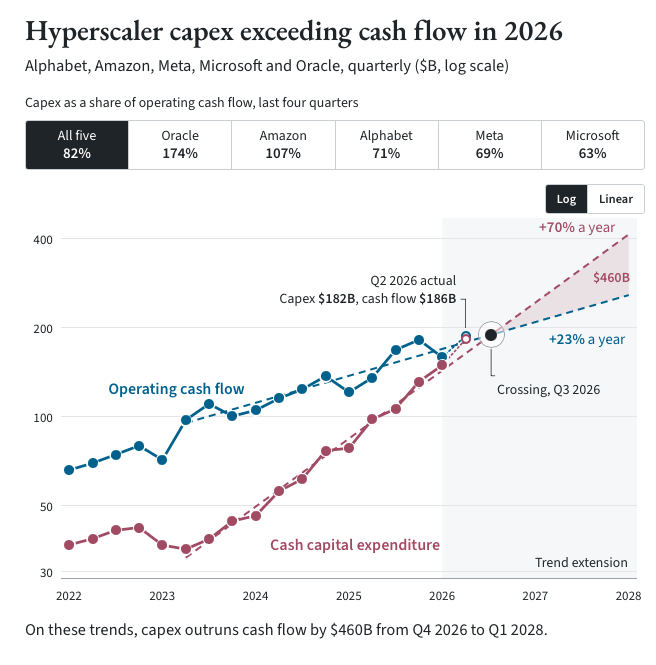
Investors, already nervous about excessive AI spend, worry that the AI investment is headed for junk bond status. Blackstone said as much to its own investors, in a sharp pivot of its own forecast for the Anthropic IPO. AI companies seem to be rapidly growing revenue while simultaneously becoming increasingly dependent on debt financing to support compute infrastructure.
(This week's tech selloff should not have surprised anyone. The S3T capital dashboard has been showing historically extreme signals for months, with valuations rising faster than outputs.)
In addition they believe a mix of drivers - not just productivity gains - will force firms to get smaller and more capital focused for reasons we'll dig into in a minute. Reading the essay made me wonder: Did the Microsoft team have an advance copy? Their decision seems to align with the reasoning put forward in the essay.
Microsoft’s own investor discussion describes pressure on cloud margins from AI infrastructure and usage alongside efficiency gains, and indicates their underlying wager is that they will need a different mix of people and technology in order to generate future value.
So let's look at 2 questions:
- Why it's not just about downsizing but fundamental restructuring, at both firm level and industry levels.
- Where it be possible to capture new value and what could that look like?
Let's start by looking at why Microsoft wanted to do this sooner than later.
A financial shift with a political clock
As Azeem Azar noted, reshaping a workforce through voluntary departures today may be easier and cheaper right now vs. later when AI displacement becomes a more politically charged issue.
There is reason to consider the political clock. New Jersey’s expanded WARN requirements, effective in 2023, include 90 days’ notice and one week of severance per year of service for layoffs, New York requires 90 days’ notice for covered events.
AI-specific proposals add another signal. New York’s proposed automation-displacement legislation would introduce notice and transition obligations. The federal FUTURE of Workers Act, introduced September 30, addresses support and retraining for workers that get displaced by automation.
These signals suggest that the cost and regulatory burden associated with layoffs is going to go up especially if public resistance to AI continues.
Where the real value will come from: AI shifts from generating powerpoint to enabling workflows
AI offerings are increasingly targeting end to end business processes, connecting systems, and handing work between people and software. Four examples:
- Anthropic’s October 28 legal artifacts package includes citation checking, contract comparison, matter tracking, and regulatory scanning. Teams can adapt the tools using their documents and connected sources, with lawyers reviewing the results. Anthropic has added more than 60 legal connectors since May. The significance is the packaging of expertise, evidence, and handoffs around recognizable tasks.
- Microsoft Copilot Studio combines agents and process automation. Its current platform overview describes a graphical environment for building agents and workflows connected to organizational systems. Workflows can incorporate agents, tools, testing, and human oversight. For enterprises, this offers a route from individual assistance toward coordinated business execution, subject to integration, governance, and operating costs.
- n8n emphasizes orchestration across systems. Its AI workflow platform combines defined process steps with agent capabilities, execution records, and human approvals, with self-hosting available. It illustrates an important design choice: use predictable automation where the process is known, and introduce model judgment where uncertainty justifies it. Every step need not become an autonomous agent.
- Liquid AI expands the local inference option. Its October 27 LFM3 release offers small, open-weight models for specialized applications. The text model card targets local agents, structured outputs, and tool calling. Local deployment avoids hosted inference charges but still requires operations and hardware. Its license also includes commercial revenue conditions so open-weight does not mean unrestricted enterprise use.
Together, these offerings lower the effort required to assemble useful workflows.
AI will also enable and rewire capital flows and this will likely impact the structure of corporations.
In the Commanding Heights essay the authors argue that tomorrow's firms will be smaller, composed of a few operators, and that venture capital and private equity will likewise be remade. Today's companies are a mix of labor and capital. The authors suspect that tomorrow's companies will have little or no "labor" in the sense of Human Resources as we think of them today. Instead they'll have "operators" ...humans yes, but hyper-talented humans who are paid and managed more like capital rather than workers.
AI will turn companies into managers of capital flow...and not just for internal cost centers and needs. Think capital flows at an industry level. Here's an example of the idea, applied to the Pharma industry.
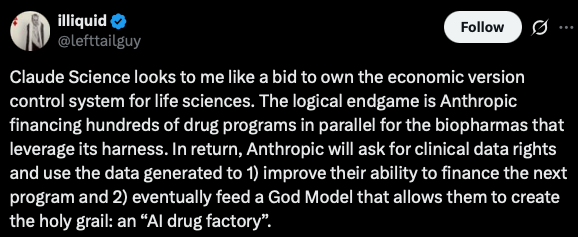
The implications for Pharma companies themselves might get interesting: Will Manidis - commenting on the thread above - wrote "the first 'primitive' we will need to lose to advance biology is the idea of a pharma company as such." Today's pharma companies - calcified vertically integrated physical entities: campus real estate, wet labs, thousands of salaried scientists, manufacturing plants,regulatory armies, and direct sales forces - are an obsolete building block, in Manidis's thinking.
Stepping back, a pharma firm, in its fundamental economic and scientific essence—is simply an engine for allocating capital to manage baskets of biological and clinical risk.
If you accept that the core job of biopharma is acquiring, de-risking, moving a molecule through clinical stages, etc then the ideal form of the process doesn’t actually require owning physical labs, factories, or massive headcount.
Think about an AI-driven, data-first paradigm for Pharma:
- Computational Discovery: AI/computational models evaluate and design candidates in silico.
- Outsourced Execution: Physical execution (assays, synthesis, clinical trial execution) is offloaded entirely to Contract Research Organizations (CROs) and tech-enabled lab infrastructure.
- Financialized Risk Management: The drug candidates themselves are treated like financial instruments (baskets of risk) that can be algorithmically evaluated, bought, bundled, and traded based on statistical probability of success.
Bottom line: at its pure theoretical core, a modern drug program is just software and financial risk management.
If our goal is to leverage AI for value in pharma, we then want to advance biology at modern speed. To do that, we have to stop thinking of a biopharma entity as a physical institution with legacy infrastructure, right? Instead, we start viewing it as a lean, software-directed vehicle that efficiently manages risk vectors to bring successful therapies to market.
So now does it make more sense why the benefits of abundant intelligence are not going to accrue to those who create frontier LLMs, or those who generate PowerPoints?
When we say AI requires us to rethink everything, it goes beyond just rethinking the business processes. We need to think about value, capital flows as well as structures at both the org and industry levels. We also need to make sure we aren't letting our organizations settle for superficial kinds of productivity gains.
False productivity: looks professional but destroys value
Across the board, companies are starting to do the math on how much human capacity to retain while buying AI capabilities intended to multiply that capacity. Their success will depend on this: Can they distinguish genuine productivity from an increasingly convincing imitation?
It's easier than ever to generate professional looking, articulate, beautifully rendered deliverables.
Consider a manager who can now produce a polished, 15-slide investment proposal in minutes. This creates a false confidence:
"Can you get me a high confidence recommendation for tomorrow morning?"
Answer usually given nowadays: "No problem!" (fires up ChatGPT)
Correct answer: "No, sorry, the team won't have validated numbers by then. You'd be making a high stakes decision based on flimsy evidence."
AI can make it easier to spawn duplicative work.
Five departments can now quickly generate five persuasive roadmaps before resolving whether they share the same priorities, dependencies, or definitions. One team’s “customer engagement” means daily product usage. Another means marketing interactions. A third means account-manager meetings. Each presentation looks coherent in isolation.
Together, they create expensive ambiguity. The organization acquires more articulate expressions of its disagreements. And more confident looking, articulate sounding recommendations that actually may be flawed.
The problem also travels downstream. Now there are:
- More presentations and architectures and proposals to verify. Someone must inspect the sources, reconcile the financial model, check the dependencies, and determine whether the recommended action is sensible.
- More apps and agents to test, harden, secure and rationalize. Teams are now creating multiple conflicting versions of apps with different tech...someone has to decide which version will go live for the customers, or how best to merge the different versions together. And by the way, while they're untangling that, the multiple apps are running up token and compute costs.
- More inconsistencies in terms and definitions. A phrase may mean one thing to one team, but something else to another. Both team's artifacts get approved; the contradictions surface during implementation or outages.
The danger: All the individuals using AI to generate these apps, reports, agents etc all can honestly claim they are getting a huge productivity gain from AI. But at the org level, it's not a net gain. The backlogs are longer, the reconciliation workloads are greater, the costs are higher. The risks are higher too, thanks to increasing numbers of decisions being made based on poorly vetted recommendations.
AI makes more things possible to build. Leadership must decide which things are worth building, establish how success will be judged, and ensure that outcomes are achieved.
Takeaways
To bring these threads together, Microsoft’s voluntary separation offer points toward a consequential transition in how companies allocate capital and organize work. Alongside that, the commoditization detailed in The Commanding Heights both point to the same structural reality: optimizing legacy processes and org charts won't be enough. True restructuring in the age of abundant intelligence means fundamentally decoupling enterprise value from labor volume, shifting away from headcount-heavy operations to refactor the firm into a lean core of high-capability operators managing capital and software orchestration.
To anticipate how this shift will cascade across their own domain, executives must look up and down their value chains to pinpoint where value will actually endure:
- Upstream (Supply & Infrastructure): Audit your dependencies on compute, raw data, and physical infrastructure.If your business model relies on generating intermediate artifacts—whether code, presentations, or computational designs—that can be commoditized by cheap, ubiquitous intelligence, your margins will inevitably collapse toward basic execution costs.
- Downstream (Workflows & Risk Management): Focus on who controls the true "commanding heights"—the domain-specific orchestration, regulatory licensing, financial settlement, and risk-allocation mechanisms. As demonstrated by the pharma model, the future belongs to asset-light vehicles that use software to orchestrate external execution and manage risk rather than owning physical, heavy infrastructure.
Ultimately, leaders must resist the illusion of "false productivity"—the high-speed generation of polished slides, isolated apps, and uncoordinated agents that inflate token bills while creating organizational friction. Restructuring requires stepping back from unit-level efficiency metrics to actively redesign both organizational architectures and industry capital flows, positioning the enterprise to own the indispensable chokepoints that machine intelligence must flow through to create real-world value.
I think there's another crucial issue here, and that is the future of employment. If AI causes corporations to divert from Coase's original theory (that firms exist because transaction workloads and costs prohibit an economy comprised solely of freelancers), then what happens to workers? I want to dig into this in the next edition.
Opinions expressed are those of the individuals and do not reflect the official positions of companies or organizations those individuals may be affiliated with. Not financial, investment or legal advice, and no offers for securities or investment opportunities are intended. Mentions should not be construed as endorsements. Authors or guests may hold assets discussed or may have interests in companies mentioned.
(c) 2026 All Rights Reserved. No part of this may be copied or shared without permission.
Member discussion